
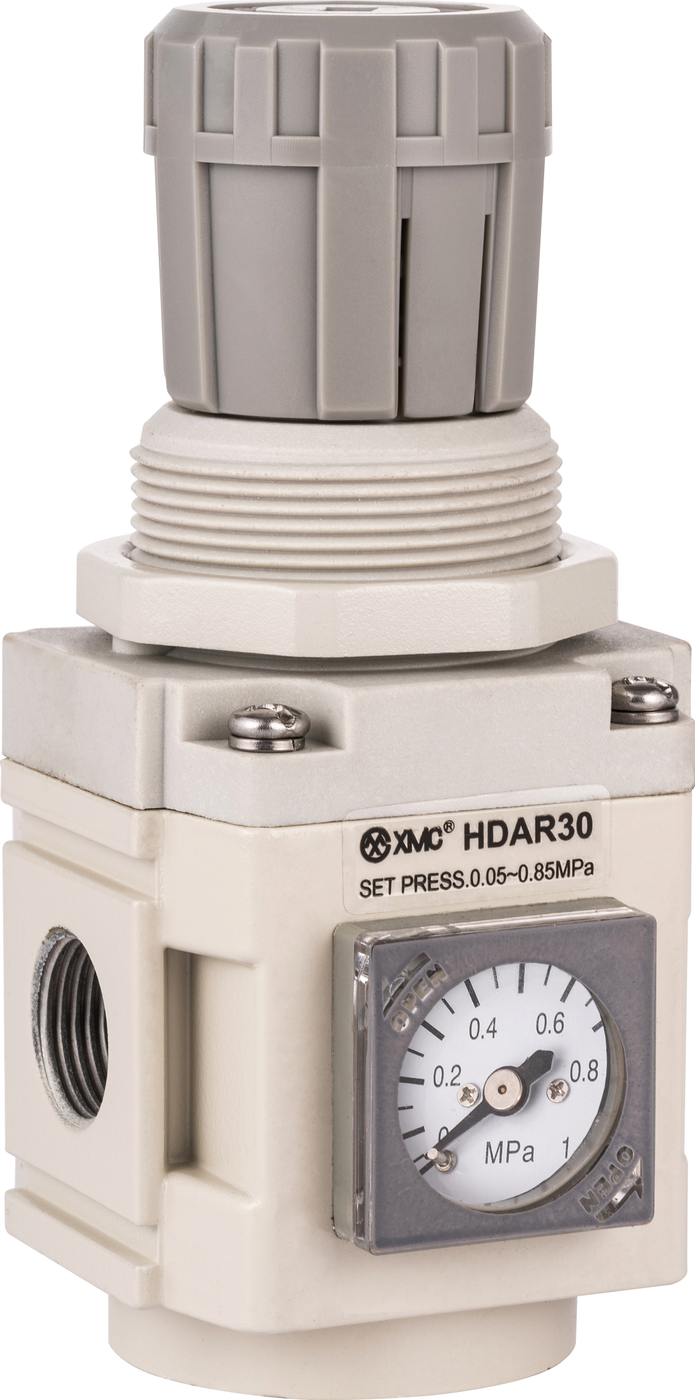
If an air regulator's outlet pressure keeps rising after air demand stops, first distinguish a brief recovery that settles from a continuing increase. Flow-related pressure drop and no-flow lock-up differ from creep associated with seat leakage. Compare inlet and outlet readings over time and check the downstream circuit before assigning a cause. Persistent or excessive pressure requires a model-specific service and protection review; changing the knob alone does not establish that the fault is resolved.
Does the pressure settle or keep climbing?
A cylinder finishes its stroke, the air nozzle closes, and the regulator gauge rises. That observation alone does not prove a faulty regulator. Droop describes lower outlet pressure as flow increases; lock-up describes an outlet-pressure increase as flow falls to zero. Creep refers to an unwanted increase typically associated with leakage through the regulator seat. [3] Record whether the pressure settles, continues upward, or changes with another machine event. Compare the behavior with the exact regulator's characteristics and the circuit's permitted pressure, rather than applying a universal acceptable rise.
Use the pressure pattern to choose the next check
Observe an approved operating cycle with the adjustment left unchanged. The following patterns help organize a technical review; they are not a bench test or a diagnosis of one failed part. A machine being idle does not establish that every downstream branch has stopped flowing.
| Observed pattern | What to review | Useful record |
|---|---|---|
| Pressure rises as demand ends, then stabilizes | Flow-related recovery and no-flow behavior | Flowing pressure, settled pressure, and whether both suit the application |
| Pressure continues rising while inlet pressure is steady | Seat sealing and the downstream circuit | Time-stamped inlet/outlet readings and the machine state |
| Outlet pressure changes as inlet pressure changes | Supply-pressure influence | Both readings during compressor or branch-supply changes |
| Pressure jumps when another branch or actuator changes state | Pressure supplied or fed back by the downstream circuit | Valve sequence, connected branches and a circuit drawing |
| The indication is erratic or inconsistent with another instrument | Gauge condition and measurement location | Instrument range, units and comparison readings |
Compare inlet and outlet readings safely
Identify P1 immediately upstream and P2 immediately downstream of the regulator or filter-regulator. Using existing suitable instruments, record both with air flowing, as the normal cycle ends, and during the following idle period. Include timestamps, units and any changes in the inlet supply. For a rapid event, a recording instrument may provide more useful evidence than a still photograph. Check the instrument range and condition before relying on its reading. Fitting instruments or servicing the circuit requires qualified personnel to isolate energy, release trapped pressure and secure loads under the machine's procedure. [6] Do not create a sealed outlet, defeat a protective device or continue operating above a permitted pressure to collect a longer trace. Send the observed trend for review instead.
Review contamination and recent pipework
Debris introduced during installation can prevent the regulating seat from sealing and allow pressure to rise downstream. Swagelok identifies this as a cause of creep; upstream filtration and clean installation help reduce the risk. [4] Review when the symptom started, any recent fitting or hose changes, and the filter's maintenance history. An external leak and leakage across an internal seat are different faults: the absence of a visible external leak does not rule out an internal problem. Replacing a filter cannot establish that a damaged regulator seat has been repaired. Ask XMC to confirm the appropriate inspection, service parts or replacement for the complete installed model.
Check the supply and downstream circuit too
A change in inlet pressure can affect the regulated outlet pressure; the direction and size of that response depend on the regulator. [3, 4] Compare P1 and P2 instead of assuming that every rise comes from a leaking seat. Also identify other paths that can pressurize the downstream side. SMC's air-regulator troubleshooting manual lists downstream back pressure above the setting as one possible cause of exhaust-port discharge. [5] This supports a circuit review, not a conclusion that every venting regulator is defective. Record whether the event follows a valve movement, another supply connection or a change in operating sequence. A drawing showing those connections is more useful than a gauge photo alone. Exhaust and backflow behavior must be checked for the actual unit.
Relieving regulation does not replace overpressure protection
A relieving regulator can vent downstream pressure through its regulating mechanism within its operating characteristics. That function does not make it a pressure safety relief valve. SMC's AR-D instructions explicitly distinguish these functions and warn that regulator failure can expose the outlet to inlet pressure. [6] Have the system designer review downstream pressure ratings and the required independent protective measures. A catalogue label such as 'with overflow' or 'relieving' does not establish a safety-relief capacity or certification. If the pressure trend threatens a component's permitted pressure or the machine's safe operation, follow the approved stop and isolation procedure and arrange a qualified assessment.
Identify the complete XMC HA or HDA model
The XMC catalogue identifies HDAR20, HDAR30 and HDAR40 as HDA air regulators, while HDAW20, HDAW30 and HDAW40 combine filtration and regulation. [1] HAR825 and HAR925 are large-size regulators in the HA range. [2] These are different product selections; a familiar knob shape or shared port size is insufficient for choosing a replacement. Send the full model code and label photo, including gauge, backflow and other options where fitted. The catalogue's pressure ranges and selection tables do not establish a universal allowable creep rate, a common repair kit or identical no-flow performance across these models. Ask XMC for the applicable technical information rather than transferring another manufacturer's ratings.
Send XMC a pressure-rise review request
A useful inquiry describes what changed, when it happens and which model is installed. If a replacement is being considered, include the required pressure and flow conditions as well as the physical connection details. State whether you need a regulator alone or a filter-regulator. The information below helps XMC review the symptom and candidate selection together.
| Information | What to include |
|---|---|
| Installed unit | Complete model code, label photograph and selected options |
| Pressure trace | P1/P2 readings with timestamps, units, flowing/idle state and adjustment setting |
| Machine sequence | What stops or switches immediately before the rise; other connected air users |
| Supply and air treatment | Inlet-pressure changes, existing filters and recent maintenance or pipework |
| Required performance | Working pressure, permitted downstream pressure, peak flow and reference conditions |
| Installation | Port size and thread standard, circuit drawing and available mounting space |
| Commercial details | Quantity, destination and required delivery date for confirmation |
Catalogue and technical references
XMC references identify the product families. The other manufacturers' documents support general regulator terminology and troubleshooting principles; their specifications, service procedures and parts do not establish XMC model performance. This guide organizes observations for a technical review and does not replace the installed equipment's operating or maintenance instructions.
- [1] XMC HDA catalogue, 21 June 2025 edition
- [2] XMC HAR large-size regulator catalogue
- [3] Swagelok Process Regulators: terminology, printed page 4
- [4] Swagelok: troubleshooting common regulator problems
- [5] SMC AR M(K)-D operation manual: troubleshooting, printed pages 14-15
- [6] SMC AR-D / AR K-D instructions: maintenance and limitations of use
Questions buyers ask.
Is pressure rising after air flow stops always regulator creep?
No. Pressure can recover as demand ends and then stabilize. A continuing increase under steady inlet conditions needs further review. Compare the trend with the regulator's documented characteristics and check the downstream circuit before concluding that the seat is leaking.
How much pressure rise is acceptable?
There is no universal bar value or percentage for every air regulator. Check the exact unit's performance information and the machine's permitted downstream pressure. An adjustment range alone does not define allowable lock-up or creep.
Will a larger air regulator stop pressure creep?
A larger unit may change flow performance, but it does not establish that a sealing or circuit problem has been resolved. Identify the cause and confirm the required performance before selecting a replacement.
Can an upstream filter fix an existing leaking regulator seat?
Filtration can reduce incoming contamination, but it cannot establish that an already damaged or contaminated seat has been restored. Confirm model-specific inspection and service with the supplier; do not dismantle a pressurized unit.
Can a relieving regulator serve as the system's safety relief valve?
Do not assume that. Regulating relief and independent overpressure protection have different duties. Have the system designer confirm the protective measures needed for downstream equipment and the exact regulator's capabilities.
Technical references
- [1] XMC Huayi HDA catalogue, 21 June 2025 edition, printed pages 54 and 58. HDAR20-40 regulator and HDAW20-40 filter-regulator identification and ordering fields. Visually checked 7 October 2026.
- [2] XMC Huayi HAR catalogue, 21 June 2025 edition, printed page 30. HAR825-925 large-size regulator identification and relieving-type description. Visually checked 7 October 2026.
- [3] Swagelok, Process Regulators MS-02-492, revision D, printed page 4: droop, lockup, creep and supply-pressure effect terminology. Accessed 7 October 2026.
- [4] Swagelok, How to Troubleshoot Common Regulator Problems, Step 2. Installation contamination, seat leakage and supply-pressure influence. Accessed 7 October 2026.
- [5] SMC, Common Supply Regulator AR M(K)-D operation manual AR-OMY0028-A, printed pages 14-15 (PDF pages 15-16). Seat contamination/damage and downstream back-pressure troubleshooting. Accessed 7 October 2026.
- [6] SMC, Regulator / Regulator with Backflow Function AR-D / AR K-D instructions AR-TF2Z352EN, sections 7 and 8. Qualified maintenance, energy isolation and the distinction between regulation and pressure safety relief. Accessed 7 October 2026.
Put the guide to work.
Choose the relevant XMC series, download its product PDF and include the application details with your inquiry.