
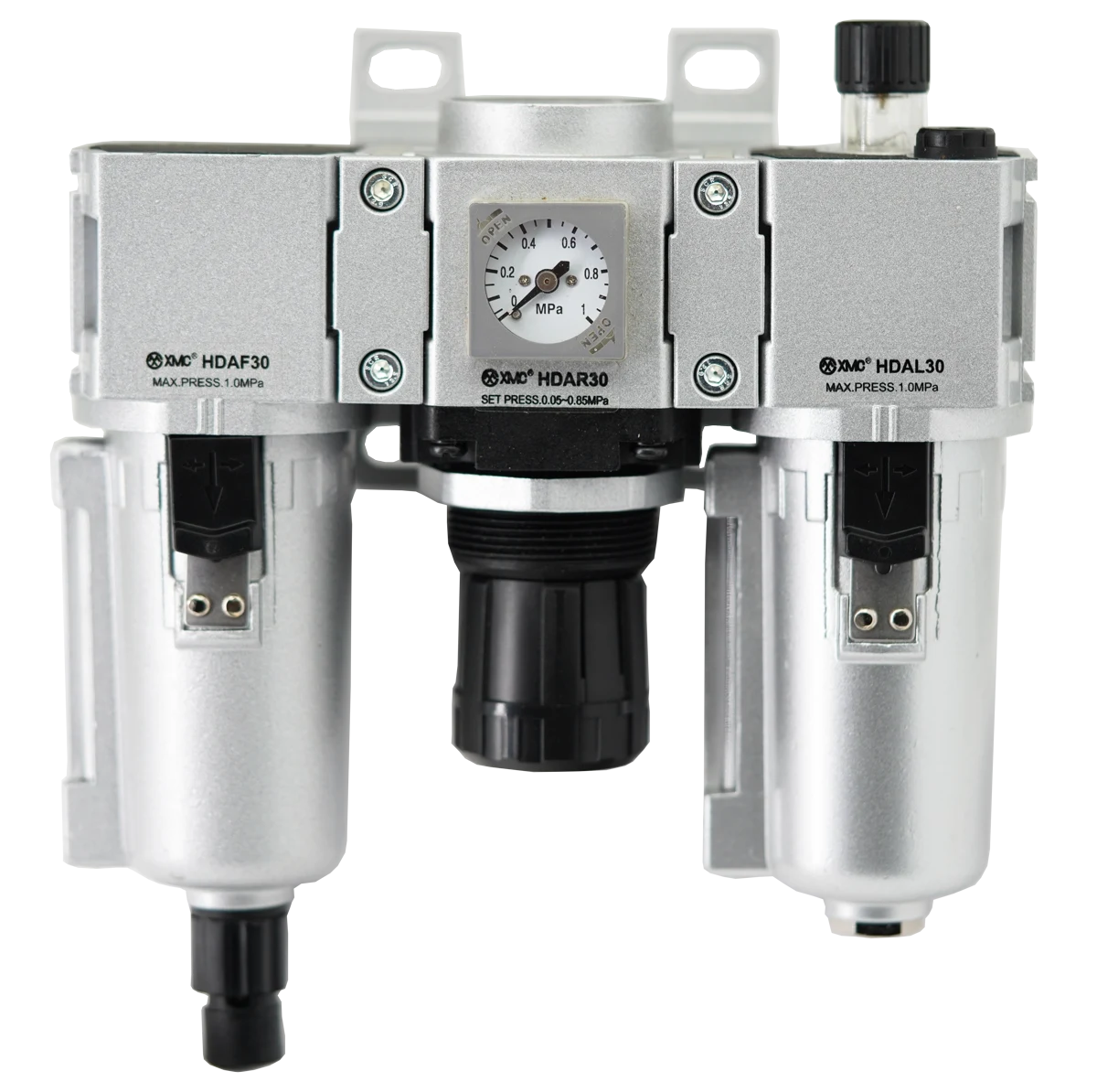
Choose an FRL connection by its complete thread designation and sealing arrangement, as well as its nominal size. BSPP usually means G threads under ISO 228-1; the ISO 7-1 family uses R, Rc and Rp markings; NPT follows a different thread standard. A description such as '1/4-inch port' does not establish a match. For an XMC HDA inquiry, send the model and existing fitting details, then ask XMC to confirm the supplied port threads and sealing requirements.
A nominal port size does not identify the thread
A buyer may know that the machine uses a 1/4-inch connection but still be missing the information needed to order an air filter or regulator. For example, Parker's comparison lists 19 threads per inch for 1/4 BSPP and BSPT, versus 18 for 1/4 NPT. [2] These nominal sizes are not a common measured thread diameter. Record the full designation from the fitting specification or drawing instead of selecting by the fraction alone.
Read G, R, Rc and Rp as different designations
BSP is a family description that needs clarification. G identifies ISO 228-1 parallel threads, commonly called BSPP. [3] BSPT describes the tapered BSP form. ISO 7-1 distinguishes tapered external R threads, tapered internal Rc threads and parallel internal Rp threads. [5] Rp therefore belongs to the pressure-tight threaded-joint family; it must not be relabelled G just because it is parallel. NPT is another tapered thread form. The table is an identification aid, not an approval to mix connections.
| Marking or name | Thread identification | Information still required |
|---|---|---|
| G / BSPP | ISO 228-1; parallel internal or external thread | Nominal size, male/female connection and separate sealing feature |
| R | ISO 7-1; tapered external thread | Size, specified mating port and assembly method |
| Rc | ISO 7-1; tapered internal thread | Size and specified external fitting |
| Rp | ISO 7-1; parallel internal thread | Specified R mating fitting; do not identify it as G |
| NPT | ASME B1.20.1; tapered thread | Size, male/female connection and installation requirements |
Check where the connection is designed to seal
ISO 228-1 threads provide mechanical fastening; a pressure-tight joint requires an appropriate seal outside the threads. [4] Depending on the end connection, this may be an O-ring, gasket, sealing washer or specified sealing surface. An ISO 7-1 R fitting with its specified Rc or Rp mating port forms the pressure-tight joint at the threads. [5] A standard NPT joint also seals at the mating threads; follow the component manufacturer's sealant and assembly instructions. [3] Thread sealant cannot correct an incompatible thread form or an unsuitable sealing face. If a fitting is approved for more than one port type, use its explicit compatibility specification rather than assuming that every similar-looking fitting shares that capability.
Identify an installed connection from records first
Start with the complete model, fitting part number, nameplate and connection drawing. Follow the machine's isolation and depressurization procedure before removing a fitting. Swagelok's identification sequence checks parallel or tapered form, diameter, pitch, thread standard and end connection. Its guide also notes that some BSPT and NPT sizes are difficult to distinguish by ordinary measurements. [3] Use measurements to support identification; if the standard remains uncertain, send the drawing and clear photographs for review instead of forcing a trial fit.
Read the HDA ordering fields without guessing the thread
The XMC HDA catalogue lists nominal port-size codes in its ordering tables. The HDAC table on printed page 48 and HDAF table on page 52 show the codes below. The round pressure-gauge option is marked G in the HDAC ordering table; this G is a gauge code, not evidence of a G-thread port. The catalogue's port-size fields do not identify the complete thread standard. Ask XMC to confirm the inlet and outlet designation and sealing requirements for the exact model. Do not create an NPT or BSP suffix from a model code that only identifies port size. [1]
| Port-size code | Nominal size |
|---|---|
| 01 | 1/8 inch |
| 02 | 1/4 inch |
| 03 | 3/8 inch |
| 04 | 1/2 inch |
Confirm flow and installation after identifying the thread
Matching the connection is one part of FRL selection. Also review the required air-treatment functions, flow demand, pressure during operation and mounting space. If an adapter is proposed, include its passage, pressure rating, sealing arrangement and added length in the review. A matching thread does not establish adequate air delivery or access for drainage and maintenance. The same connection checklist is useful when discussing HA or large-port HA equipment, using the documentation for that exact series.
Send a complete FRL connection inquiry
For a replacement, send the existing unit and fitting references together. For a new machine, specify the proposed connections and explain which details are still open. Mark unknown fields as unknown so that XMC can review them before a configuration is confirmed. The example in the worksheet describes a buyer's existing fitting; it is not an XMC model or a promise that a particular HDA thread version is available. Include quantity and destination with the technical information.
| Field | Useful information to send |
|---|---|
| Unit | Exact XMC or existing model; filter, regulator, lubricator or combination required |
| Each connection | Inlet and outlet separately: nominal size, thread standard and male/female form |
| Mating fitting | Part number, connection drawing and full designation; for example, an existing G 1/4 male fitting |
| Seal and adapter | Specified seal or sealing face; any proposed adapter and its drawing |
| Operating conditions | Compressed-air requirements, working pressure, required flow with reference units and demand timing |
| Installation | Connection layout, available space, drain arrangement and service access |
| Quotation | Quantity, destination, photographs and the fields needing confirmation |
Catalogue and technical references
The HDA ordering information comes from the XMC catalogue. The standards and other manufacturers' guides explain thread identification and sealing principles; they do not establish which thread versions XMC supplies. Confirm the complete XMC configuration before ordering.
Questions buyers ask.
Is a G thread the same as BSPP?
G is the ISO 228-1 parallel pipe-thread designation commonly described as BSPP. Confirm the full nominal size and end connection too, because the thread name alone does not specify the sealing feature.
Is Rp the same as G because both are parallel?
No. Rp identifies an ISO 7-1 parallel internal thread for a pressure-tight threaded joint with its specified R mating fitting. G identifies ISO 228-1 threads with a separate sealing arrangement. Keep those designations distinct.
Can I connect a 1/4 NPT fitting to a 1/4 BSP port?
Do not select a direct connection from the nominal fraction alone. Confirm both complete thread specifications and the approved mating arrangement, or use a correctly specified adapter. Applying more sealant does not change the thread standard.
Does G in an HDA ordering code identify a BSPP port?
In the published HDAC ordering table, G identifies the round pressure-gauge option. It must not be interpreted as a port-thread suffix. Confirm the exact model's connection standard separately with XMC. [1]
What if I only know the HDA model and port size?
Send those details with the mating fitting's part number, drawing or clear photographs. State that the thread standard is unconfirmed. Ask XMC to verify the supplied inlet and outlet connections, sealing requirements and complete ordering configuration.
Technical references
- [1] XMC Huayi HDA Series Air Preparation Units catalogue, printed pages 48-59. HDAC ordering fields on page 48 and HDAF fields on page 52; nominal port codes and the separate round-gauge G option. Accessed 5 October 2026.
- [2] Parker, ISO Conversion Fittings, Typical Fastening Threads and Comparison of Thread Forms. BSPP/BSPT 1/4-19 versus NPT 1/4-18. Accessed 5 October 2026.
- [3] Swagelok, Thread and End Connection Identification Guide MS-13-77, revision H. Identification sequence on printed pages 7-10; measurement limitations on pages 13-14; NPT on page 24; ISO 228-1 end connections on pages 37-42 and glossary on page 54. Accessed 5 October 2026.
- [4] ISO 228-1:2000, public scope and abstract. Parallel fastening threads and sealing outside the threads. Accessed 5 October 2026.
- [5] ISO 7-1:1994, section 4 Symbols, printed page 2 in the SIST ISO 7-1:1995 public preview. R tapered external, Rc tapered internal and Rp parallel internal thread designations. Accessed 5 October 2026.
Put the guide to work.
Choose the relevant XMC series, download its product PDF and include the application details with your inquiry.