
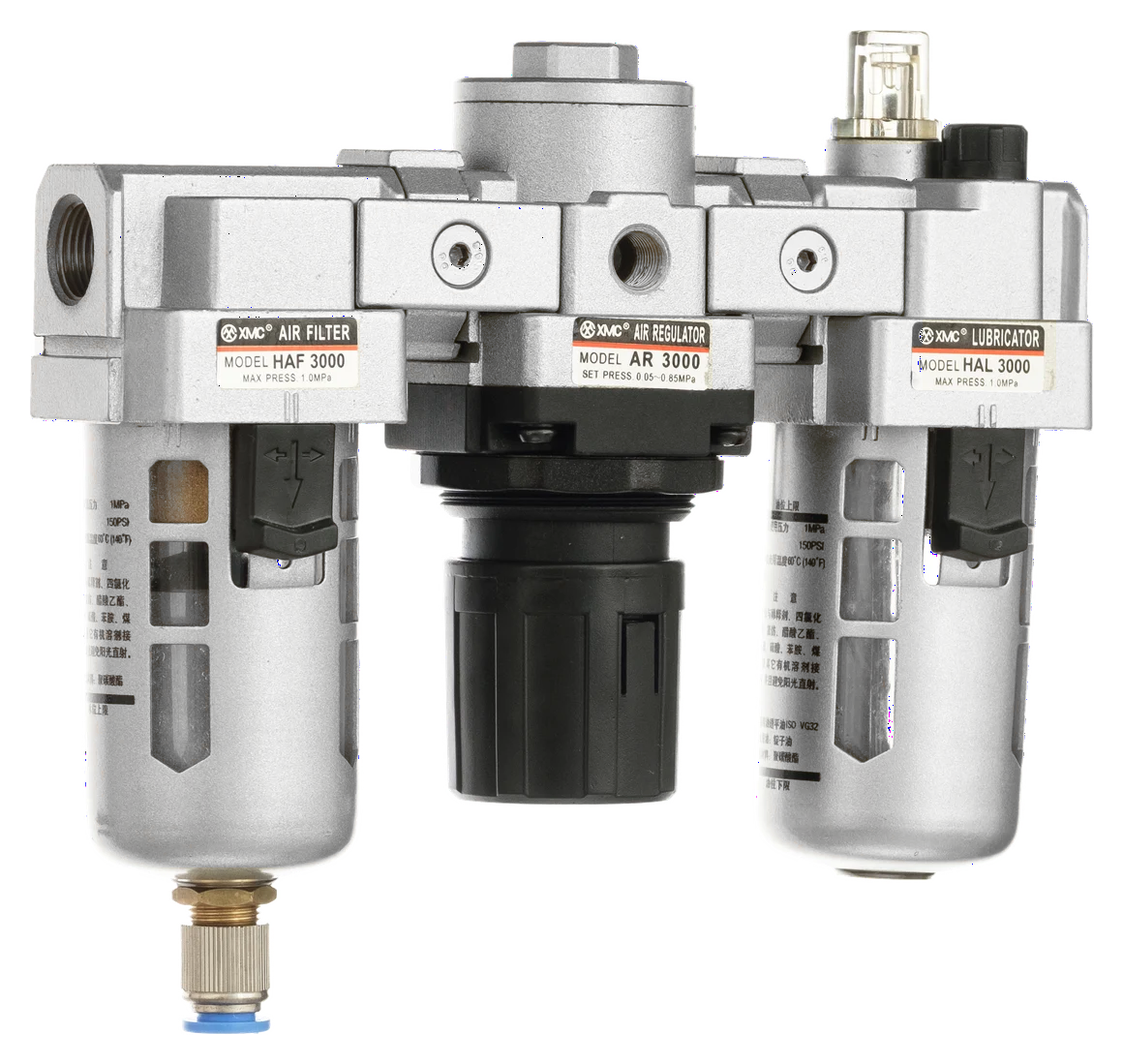
Review an HA-to-HDA change as a new configuration approval. Record the old complete model and required functions, then check the proposed HDA code against the actual threads, mounting, dimensions, drain, accessories and operating conditions. Compare the old and proposed evidence in one change ledger. A similar size number, matching port entry or shared pressure range does not establish a drop-in replacement or equal capacity.
Start with the installed unit, not a family-name substitution
Photograph the existing label and the complete station from the inlet, outlet, front and mounting sides. Record every module, connected fitting, drain tube, gauge or switch, mounting item and accessory code that can be identified. Keep the original drawing revision with those records. If a label is unreadable, send the photographs for identification rather than converting its apparent body size into a proposed HDA code. The purpose of the change review is to make every retained requirement visible before a quotation changes the hardware.
Carry forward functions before comparing model numbers
The HA catalogue separates HAC F+R+L combinations, HAC FR+L combinations and HAW filter-regulators. Its HDA counterpart identifies HDAC F+R+L, HDAC-A FR+L and HDAW F+R. [1, 2] Those function labels help organize a review; they are not replacement mappings. For example, selecting a two-piece HDAC-A still includes lubrication, while an HDAW alone does not. If the installed station supplies lubricated air that the machine requires, do not remove that function merely to match the desired housing count. Conversely, confirm the machine requirement before carrying a lubricator into a new branch.
Use an old-versus-proposed change ledger
Give each requirement three entries: existing evidence, proposed evidence and the decision or missing item. Mark a field unknown when it has not been confirmed. A quotation should refer to the same ledger and drawing revision as the technical review. This prevents a later substitution of a drain, gauge or fitting from being mistaken for an unchanged order.
| Review item | Existing evidence to retain | Proposed evidence to obtain | Close the item when |
|---|---|---|---|
| Function and complete identity | Label, module list, required F/R/L functions and current options | Complete HDA model, options and supplied-item list | Each required function is accounted for and any deliberate change is approved. |
| Connections | Thread form, size, fitting/seal arrangement and inlet/outlet orientation | Exact mating-interface specification and any new fittings | Each interface has a supported connection; no suffix is guessed. |
| Mounting and access | Measured hole pattern, panel thickness, envelopes and service route | Applicable drawing, bracket/hardware and service clearance | The completed proposed layout is checked against the installation. |
| Drain and bowl | Actual pressure cycle, discharge route, environment and current drain | Selected mechanism, bowl/cover and supplied operating instructions | Operation and discharge are suitable for the stated duty. |
| Pressure and demand | Lowest supply, outlet requirement, demand sequence and measurement points | Applicable selected-model performance data and whole-path review | The required operating conditions are supported, not only the idle setting. |
| Spares and handover | Existing maintenance task and spare-item identifiers | Confirmed compatible service items and change instructions | The revised maintenance and commissioning record is accepted. |
A hypothetical HAW3000-to-HDAW30 drawing check
Suppose an engineer is reviewing an existing HAW3000-03 against a proposed HDAW30-03 for an F+R task. This is an illustrative document review, not an approved replacement. Both catalogue entries include a 3/8 main-port option. The individual drawings list dimension A as 53 mm for both body groups, but dimension B is 218 mm for HAW3000 and 231 mm for HDAW30. [1, 2] That single difference is enough to require a fresh layout check. Even matching dimensions would not establish common mounting or sealing. Use each original drawing to interpret its dimension letters and datums, then obtain the exact drawing for the selected drain, gauge and bowl options.
| Catalogue drawing entry | Main port entry relevant to the example | Drawing A | Drawing B | Evidence still needed |
|---|---|---|---|---|
| HAW3000, printed page 28 | HAW3000-03: 3/8 in the G-port table | 53 mm | 218 mm | As-installed options, actual thread, mounting and service envelope. |
| HDAW30, printed page 59 | HDAW30-03: 3/8 in the model table | 53 mm | 231 mm | Complete proposed code, supplied thread, selected-option drawing and connection/mounting plan. |
Confirm each thread, fitting and mounting interface
The HA pages use G-port entries and note other thread availability. A nominal port number on a proposed HDA row does not by itself confirm the supplied thread or the old fitting's sealing arrangement. [1, 2] Record the thread form and sealing method in words on the inquiry. Have the mating fittings confirmed, including any adapters and their impact on the installed envelope. Check brackets, fixing holes, panel cut-outs and the direction of adjustment and gauge viewing. Existing connecting parts are identified items to verify, not reusable parts merely because both stations carry an XMC label.
Compare operating evidence on a common basis
HAW and HDAW tables list pressure-adjustment limits, but matching limits do not establish the same flowing outlet performance. The HA catalogue uses rated-flow entries with stated conditions, while the HDA pages include characteristic plots. [1, 2] Preserve the source and conditions behind each number; do not copy one nominal flow across families or compare it to an unqualified curve endpoint. Send the actual lowest inlet pressure, required outlet pressure at the stated measurement point, peak and low demand, and demand duration. Ask XMC to review the complete proposed path, including changed fittings. Norgren's general selection guidance similarly calls for inlet pressure, controlled outlet pressure and flow. [3]
Treat drain, bowl and accessories as changes with consequences
Do not carry a drain description across the project simply because the previous unit appeared to discharge automatically. Record whether the existing branch remains pressurized after a stop, where discharge goes and what operating conditions the proposed drain requires. The HDA ordering pages have separate drain and bowl/cover choices; the regulator and filter-regulator pages also distinguish gauge and switch options. [2] Obtain the exact configuration and relevant instructions. Confirm the environment and permitted cleaning method for the selected bowl instead of assuming that a similar clear appearance proves material or chemical compatibility.
Approve a proposed arrangement and its handover record
Before placing the changed order, collect the confirmed complete model, selected-option drawing, connection and mounting list, operating review, required service parts and commissioning instructions. Agree where outlet pressure will be checked, during which machine sequence and against which machine requirement. A successful idle gauge setting alone does not close the demand review. Have the responsible person confirm the revised installation and maintenance documents. If an item remains unresolved, name that dependency in the quotation rather than describing the proposed unit as interchangeable.
Catalogue and technical references
The ledger is an engineering purchasing method. It does not supply a compatibility chart. The hypothetical HAW/HDAW pair demonstrates how published drawings can expose a change requiring review; it is not a tested retrofit, capacity comparison or statement of current stock. Use the catalogue pages and a supplier-confirmed proposal for the actual project.
Questions buyers ask.
Is there a direct HA-to-HDA replacement table in this guide?
No. It provides a project-review ledger. Confirm the full old and proposed models, functions, interfaces, drawings and operating requirements before approving a change.
Does HAW3000-03 directly interchange with HDAW30-03?
That is not established. They appear only in a hypothetical document comparison. Their drawing rows differ, and matching nominal ports do not settle thread, mounting, accessories or capacity.
Can I keep the old brackets and fittings?
Identify the exact items and obtain confirmation against the proposed model and drawing. A shared brand or similar body width does not establish that they are suitable.
Does changing from three pieces to two pieces remove lubrication?
Not for an HDAC-to-HDAC-A function comparison: both include lubrication. HDAW alone is a filter-regulator. Carry the required functions forward explicitly rather than using housing count to decide.
What should I send if the old nameplate is unreadable?
Send clear views of the unit, modules, ports, connections and mounting, plus any original drawing or spare-order record. Include operating pressure, flow and required functions; do not guess a complete old code from appearance.
Technical references
- [1] XMC Huayi Pneumatic Catalogue, edition 21 June 2025, printed pages 24-28: HA combination and component identities, HAW model/port table and HAW3000 drawing A=53/B=218 mm. Original customer PDF and published extract visually checked 26 October 2026.
- [2] XMC Huayi Pneumatic Catalogue, edition 21 June 2025, printed pages 48-59: HDAC/HDAC-A functions, HDA ordering choices and HDAW30 drawing A=53/B=231 mm on page 59. Original customer PDF and published extract visually checked 26 October 2026. No HA/HDA interchangeability is stated.
- [3] IMI Norgren, How do Pneumatic Pressure Regulators work?: separate inlet, controlled-outlet and flow selection inputs. Read 26 October 2026. No Norgren specification is assigned to XMC.
Put the guide to work.
Choose the relevant XMC series, download its product PDF and include the application details with your inquiry.