
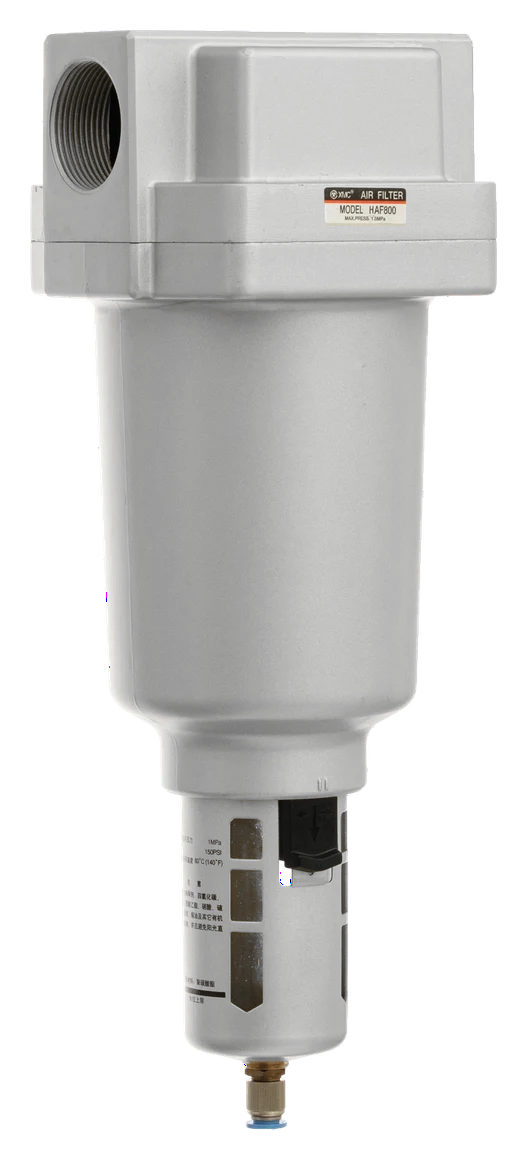
For a larger distribution branch, choose HA components by the functions required and the pressure and flow needed during overlapping demand. HAF filters, HAR regulates, and HAL adds lubricating oil where the equipment requires it. Confirm each complete model, thread, flow-data conditions and service clearance separately. A common HA family name or matching port size does not establish a compatible assembled station.
Map the distribution branch before selecting a large port
Start with a branch drawing showing the supply connection, proposed treatment position and every downstream user. Mark shared sections and where the line divides. Include blow-off, vacuum generation and future users as well as cylinders. Record which devices run together and the duration of each demand window. A shift average cannot describe a short overlap. Use the same flow units and reference conditions throughout the demand record. Identify the lowest supply pressure observed during the demanding sequence and the pressure each user needs. This branch brief gives a supplier more useful information than the pipe diameter alone.
Separate HAF filtration, HAR regulation and HAL lubrication
The XMC HA catalogue lists these as separate components. HAF is an air filter, HAR adjusts downstream pressure, and HAL supplies oil mist. [1–3] Select the functions from the equipment requirements before choosing bodies or connectors. Do not add a lubricator simply to complete the letters FRL. A common supply may serve users with different lubrication requirements; ask the machine designer to define the appropriate branch arrangement. The following ports identify catalogue entries to review. They do not establish equal capacity, direct mechanical coupling or an approved combination.
| Family and function | Listed model / port entries | Selection point |
|---|---|---|
| HAF air filter | HAF800-12: G1 1/4; HAF800-14: G1 1/2; HAF900-20: G2; HAF930-30: G3 | Confirm filtration, drain and the exact flow-data conditions. |
| HAR pressure regulator | HAR825-14: G1 1/2; HAR925-20: G2 | Check inlet pressure, controlled outlet pressure and flowing performance. |
| HAL oil-mist lubricator | HAL900-14: G1 1/2; HAL900-20: G2 | Use only where lubrication is required; check minimum operating flow. |
Read the conditions behind the flow number
The HAF table states rated flow at 0.7 MPa supply pressure and a 0.05 MPa pressure drop. The HAR table instead states 0.7 MPa supply pressure and 0.5 MPa set pressure. [1, 2] These are different conditions. Do not rank the units by their flow-column numbers or treat either value as a complete station rating. Both pages use L/min without defining the reference state there. Ask XMC to confirm the basis before comparing normalized flow or a meter reading. Request applicable performance data for the actual model, filtration grade, inlet condition and required downstream pressure.
Give pressure loss a location and a demand window
Review the shared air path and the branches after it. Festo identifies service-unit restrictions, long lines, branches and leaks as possible causes of inadequate flow and pressure. [4] Specify where pressure is measured and which devices were operating. Separate loss across a filter from a regulator’s change in outlet pressure as demand increases; these are different observations. IMI Norgren recommends considering inlet pressure, controlled outlet pressure and flow characteristics when selecting a regulator. [5] A large connection cannot establish that the most distant user receives enough pressure. Use the permitted operating pressure at that user as the requirement, rather than inventing one acceptable pressure-drop percentage for every installation.
Check HAL at low demand as well as the peak
The HAL900 catalogue lists 1,000 L/min as minimum flow for oil delivery. [3] This is not maximum capacity. The page does not define the flow reference state or a detailed test method, so do not relabel the value ANR, NL/min or SCFM. Send the lowest operating demand, peak demand and cycle duration for review. SMC explains that lubricator minimum charging flow concerns the pressure difference needed to produce oil dripping. [6] Its test conditions and drip guidance are not HAL specifications. A branch with a high brief peak can still spend much of its operating cycle at lower demand.
Confirm threads, drains and service access as separate decisions
The port entries above use the catalogue’s G designation. Confirm the complete supplied thread and sealing arrangement for each component and adjoining fitting. HAF lists D-suffix automatic-drain models; specify the drain rather than identifying it from a photograph. [1] Check the installed envelope, bowl access, drain discharge route, regulator adjustment access and lubricator servicing requirements. A G3 HAF930 entry does not establish a matching G3 HAR or HAL in these pages. Have XMC confirm the proposed layout and connectors. Before fitting measurement connections or servicing components, follow the machine’s isolation procedure, release trapped pressure and secure loads.
Send XMC a distribution-branch selection brief
Supply the branch drawing and operating record together. If demand is unknown, identify the users and their cycle sequence instead of substituting compressor output. Keep planned expansion separate from measured demand. State which values are measured, estimated or still unknown. Ask for a review of each component and the proposed connected arrangement, including the data needed to confirm it. After an approved installation, verify the intended simultaneous sequence against the machine requirements before accepting the selection.
| Selection input | What to send |
|---|---|
| Users and timing | Branch drawing, overlapping users, peak duration and minimum operating demand. |
| Pressure and flow | Measurement locations, lowest flowing inlet pressure, required user pressure, flow units and reference conditions. |
| Required treatment | Filtration grade, drain, downstream air-quality requirement and whether lubrication is permitted or required. |
| Connections and space | Complete models, threads, pipe or hose dimensions, connectors and available service clearance. |
| Purchasing scope | Quantity, destination, requested delivery date and any documentation requirements for confirmation. |
Catalogue and technical references
XMC product identities and the stated catalogue details come from printed pages 29–31. Other manufacturers’ references explain general selection principles; their ratings, test conditions and accessories are not assigned to HA products.
Questions buyers ask.
Can HAF, HAR and HAL be ordered as one matched HA station?
Do not assume this from the family name. Confirm the complete models, required functions, threads, connecting parts, layout and performance with XMC. The three catalogue pages describe separate components, not every possible assembled combination.
Does a G3 HAF filter mean the whole station can use G3 components?
No. HAF930-30 is listed with G3 ports, while the HAR and HAL entries reviewed here list G1 1/2 and G2. Ask XMC to review the intended connection arrangement and capacity instead of assuming a corresponding G3 regulator or lubricator.
Is HAL900’s 1,000 L/min value its maximum flow?
No. The catalogue labels it minimum flow for oil delivery. Confirm the reference conditions and suitability across the actual operating demand range. Maximum usable flow and acceptable pressure loss require separate performance information.
Can I compare HAF and HAR rated flow directly?
Their catalogue footnotes use different pressure conditions. Compare the exact model and applicable operating data, including the flow reference state. Neither table by itself rates an assembled filter, regulator, lubricator and distribution line.
Technical references
- [1] XMC Huayi Pneumatic Catalogue, edition 21 June 2025, printed page 29: HAF model ports, rated-flow conditions and drain entries; checked 20 October 2026.
- [2] XMC Huayi Pneumatic Catalogue, edition 21 June 2025, printed page 30: HAR825/HAR925 ports and rated-flow conditions; checked 20 October 2026.
- [3] XMC Huayi Pneumatic Catalogue, edition 21 June 2025, printed page 31: HAL900 ports and minimum oil-delivery flow; checked 20 October 2026.
- [4] Festo, air-preparation white paper, printed page 6: sufficient flow, pressure and distribution restrictions; accessed 20 October 2026.
- [5] IMI Norgren, How do Pneumatic Pressure Regulators work?: inlet pressure, controlled outlet pressure and flow selection factors; accessed 20 October 2026.
- [6] SMC, Air Combination Selection Guide, printed page 111: lubricator minimum charging flow as a separate characteristic; accessed 20 October 2026. Competitor test conditions are not HAL ratings.
Put the guide to work.
Choose the relevant XMC series, download its product PDF and include the application details with your inquiry.