
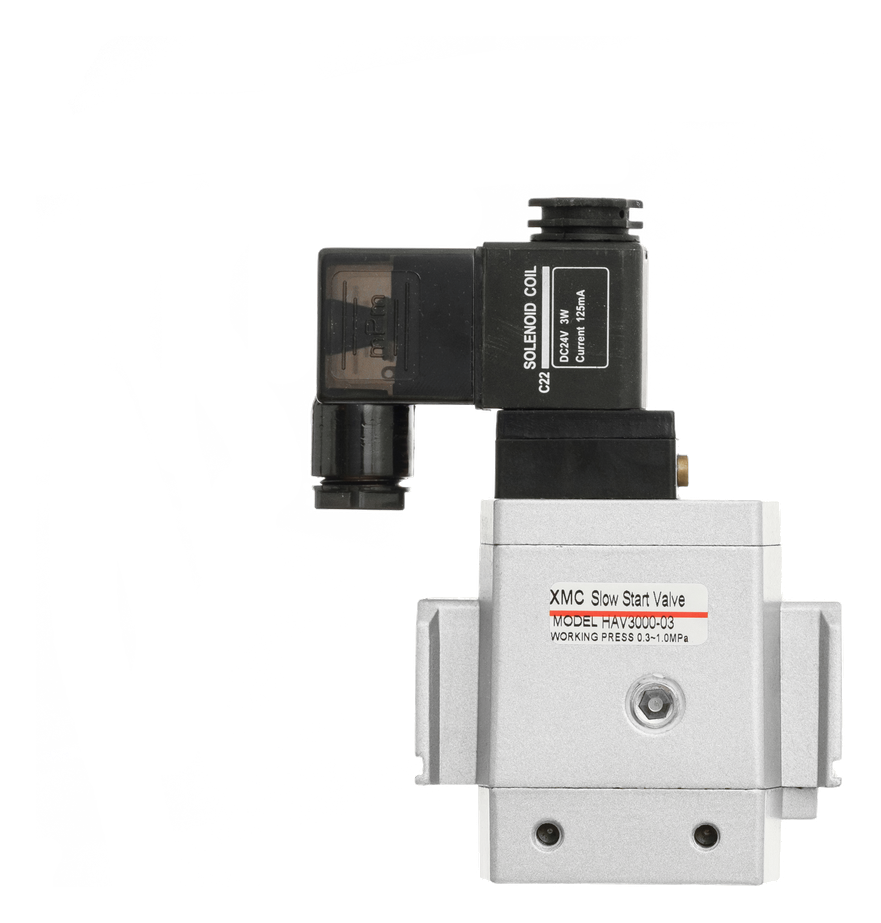
A pneumatic soft-start valve restricts the initial airflow so a depressurized circuit fills gradually, then admits normal flow. In the XMC HAV catalogue, full opening occurs when outlet pressure reaches half the inlet pressure; closing provides a residual-pressure exhaust path. Use it to manage the return of air at startup. Select the initial filling behavior and the normal running capacity separately: neither port size nor a desired delay in seconds is a complete valve specification.
Why the first air supply deserves attention
When a depressurized machine receives air again, its pipework, valves and actuators must refill. The first movement can differ from a normal cycle, depending on valve states and the load. Soft-start addresses this initial pressure rise; SMC describes gradual pressurization as a way to reduce system shock. [2] Start with a precise question: should air return gradually after isolation, or is the real problem cylinder speed or a pressure dip during every cycle? The answer determines which function to investigate.
How the XMC HAV startup sequence works
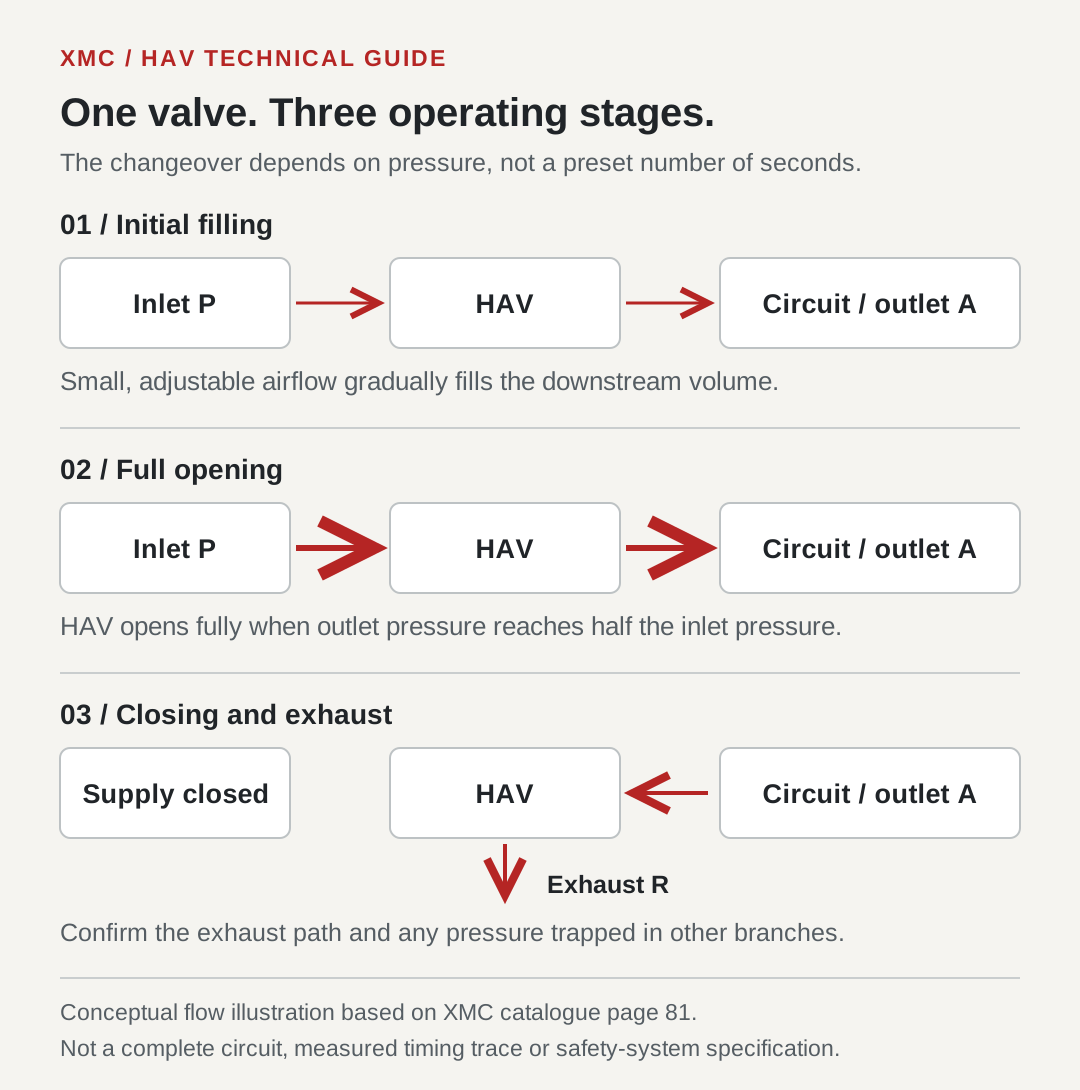
The XMC catalogue describes three operating stages. First, a small, adjustable airflow fills the downstream circuit. When outlet pressure reaches half the inlet pressure, HAV opens fully. Closing the valve then allows residual downstream pressure to exhaust through the valve. [1] For illustration, a steady 0.6 MPa inlet gives a catalogue changeover point of 0.3 MPa at the outlet. This arithmetic example is not a measured startup curve or a promised filling time. Connected volume, the initial-flow setting and air consumption during filling affect when the threshold is reached.
| Stage | Valve function | What the machine builder should confirm |
|---|---|---|
| Initial filling | Admits a small, adjustable airflow | Required pressure-rise behavior and downstream volume |
| Normal supply | Opens fully at the documented pressure relationship | Available flow at the actual operating pressure |
| Closing | Provides residual-pressure exhaust through the valve | Exhaust path and any pressure trapped elsewhere in the circuit |
Soft-start, shut-off and regulation do different jobs
A soft-start function controls the initial pressure rise. A basic shut-off function opens or closes the air supply; it does not, by that description alone, specify a controlled filling stage. Festo distinguishes these functions and offers combinations, so identify the functions of the exact valve rather than relying on its name. [3] Pressure regulation is another task: a regulator establishes the intended downstream working pressure. Adding HAV does not remove the need to specify the regulator or review the rest of the air-preparation assembly.
| Question | Function to review | Do not assume |
|---|---|---|
| How should pressure return after air-on? | Soft-start or controlled filling | Every on/off valve includes an adjustable filling stage |
| How is the air supply stopped? | Shut-off and any required exhaust function | Every shut-off design also vents the downstream circuit |
| What pressure should the machine run at? | Pressure regulation | A soft-start valve maintains the regulator's pressure setting |
Does a soft-start dump valve also provide lockable isolation?
A soft-start dump valve can combine controlled filling with an exhaust function; Festo offers valve configurations with and without soft-start. [3] For XMC HAV, the catalogue documents both adjustable initial filling and residual-pressure exhaust when the valve closes. [1] The separate HVHS product page identifies manual three-port, two-position operation, while its catalogue describes secondary-side pressure release and a locking function. [6] These are distinct selection requirements. Ask which position can be locked and how the selected valve connects supply, outlet and exhaust in each state. An exhaust description does not prove that every branch empties, and a lock feature alone does not establish a certified machine-safety function. Review the complete circuit and required evidence. [4]
| Required behavior | Documented starting point | What still needs confirmation |
|---|---|---|
| Gradual return of air | HAV: adjustable initial filling, followed by full opening | Downstream volume, pressure rise and normal running flow. |
| Residual-pressure exhaust on closing | HAV: exhaust described in its closing sequence | Exhaust route and any downstream pressure trapped by other components. |
| Locking and secondary-side pressure release | HVHS: manual three-port, two-position valve with downstream venting and a lockable control | Exact locked state, connections, circuit isolation boundaries and required documentation. |
When to consider a soft-start valve
Consider controlled filling when an assembly station, packaging machine or other pneumatic circuit is depressurized and returned to service. A hypothetical fixture station may need air restored before the controller enables its normal sequence. Document the connected volume, initial actuator positions and pressure required before operation. Use the symptom below to decide whether the soft-start function is the appropriate part of the investigation; the table is a review guide, not a diagnosis of a particular machine.
| Observed requirement or symptom | Review first | Information to record |
|---|---|---|
| Pressure must return gradually after isolation | Soft-start behavior and permission-to-run sequence | Initial valve states, connected volume and downstream pressure rise |
| Cylinder is too fast during every normal cycle | Actuator flow controls and load | Extension/retraction behavior during normal running |
| Working pressure falls while the machine consumes air | Supply capacity and pressure loss | Inlet and outlet pressures during the same operating event |
| Pressure never completes the filling stage | Supply, initial-flow setting and downstream air consumption | Leaks, open consumers and drain behavior during startup |
Compare HAV2000, HAV3000 and HAV4000
The three sizes presented on the XMC HAV product page have different connections and effective areas. The following values come from printed catalogue page 81. Effective area is expressed in mm²; it is not a flow rating in L/min. Share the required flow, reference conditions and allowable pressure drop so the valve can be reviewed as part of the complete air path. A larger connection by itself does not establish a suitable filling time or available running flow.
| Model | Port size | Supply effective area: 1(P) to 2(A) | Exhaust effective area: 2(A) to 3(R) |
|---|---|---|---|
| HAV2000 | 1/4 inch | 20 mm² | 24 mm² |
| HAV3000 | 3/8 inch | 37 mm² | 49 mm² |
| HAV4000 | 1/2 inch | 61 mm² | 76 mm² |
Specify the control, pressure and connections
The reviewed HAV catalogue lists 0.3 to 1.0 MPa working pressure and an ambient/fluid temperature range of 0 to 60 °C. Electrical versions list 12 or 24 V DC and 110 or 220 V AC, with grommet leads or a DIN connector. A pneumatic-control option is also shown; its listed minimum pilot start pressure is 0.2 MPa. That pilot value does not replace the valve's working-pressure range. Confirm G, Rc or NPT threads, the full ordering code and the mounting dimensions on pages 81–82. [1]
Check automatic drains before deciding the valve position
Festo warns that placing soft-start upstream of a normally open automatic or semi-automatic condensate drain can prevent pressure building: air escapes through the drain before enough pressure is reached to close it. [5] Treat this as a circuit-layout check, not a claim that every drain behaves the same way. Identify the fitted HDA drain type and its closing requirements, then ask XMC to confirm the HAV position and complete assembly. During commissioning, assess the pressure rise against the machine procedure with the intended valve states. Increasing initial flow without checking the cause can conceal a layout or leakage problem.
Review the circuit as well as the valve
Record inlet and downstream pressure during startup, the intended initial valve positions, normal flow demand and the exhaust arrangement. The machine's commissioning procedure should establish when its operating sequence may begin. A soft-start function alone does not establish a certified machine-safety function or guarantee that every branch has depressurized. Festo's safety guidance treats pressure control, exhausting and protection against unexpected startup as functions requiring an appropriate system design. [4] Where these are required, include the machine risk assessment and required safety documentation in the selection review.
What to send with an HAV inquiry
Send a circuit sketch and describe what should happen when air is restored and when supply is stopped. Include inlet and working pressure, peak running flow with its reference conditions, approximate downstream volume, port size and thread, electrical supply or pneumatic pilot details, available mounting space and quantity. Identify the existing air-preparation model and any required safety documentation. XMC can then review the complete HAV configuration against the application instead of treating a port-size match as the final selection.
| Requirement | Information for the selection review |
|---|---|
| Controlled filling | Depressurized volume, initial valve states, pressure required before running and the intended pressure-rise behavior. |
| Normal operation | Peak flow and reference conditions, lowest flowing inlet pressure and permitted pressure loss. |
| Shutdown and exhaust | A circuit sketch identifying supply, downstream branches, non-return or pressure-retaining devices and the intended exhaust path. |
| Locking and restart | Whether a lockable function is required, the intended locked state and who defines the machine restart procedure. |
| Complete ordering configuration | Exact model, G/Rc/NPT thread, control type, voltage or pilot supply, connector, mounting space and quantity. |
Catalogue and technical references
HAV model data and the operating sequence above follow the XMC catalogue. The external references explain general functions and system considerations; their model-specific ratings and certifications are not assigned to HAV. The fixture station and pressure calculation are illustrative; the diagram shows functions only. The HVHS reference identifies its stated venting and locking functions only; it does not establish HAV/HVHS interchangeability or a complete machine isolation design.
Questions buyers ask.
Does every pneumatic machine need a soft-start valve?
The need depends on the circuit and its required startup behavior. Review how the machine is repressurized, its initial actuator and valve states, and the control sequence before specifying the function.
How many seconds does an HAV valve take to open fully?
The reviewed catalogue describes a pressure-based transition, not a universal time: full opening occurs when outlet pressure reaches half the inlet pressure. Filling time depends on the connected volume, initial-flow setting and air consumption.
Should a soft-start valve go before or after an automatic drain?
Check the exact drain behavior and the approved assembly layout. A normally open drain downstream of restricted initial flow can prevent pressure from building enough to close the drain. Confirm placement and startup requirements for the selected HAV and HDA configuration; do not use a universal installation order.
Is a soft-start valve the same as a cylinder speed controller?
No. Soft-start describes the initial pressurization of the supplied circuit. Cylinder speed during normal operation depends on the actuator circuit, flow controls and load, which need their own review.
Can I use the 0.2 MPa pilot figure as HAV's minimum working pressure?
No. The reviewed catalogue lists 0.2 MPa as the minimum start pressure for the pneumatic pilot, while the working-pressure range is 0.3 to 1.0 MPa. Confirm both requirements for the selected configuration.
Does HAV replace a certified safety exhaust valve?
Do not infer that from the soft-start or residual-exhaust description. If the machine requires a certified safety function, specify the required architecture and supporting evidence separately and have the complete circuit reviewed.
Is a soft-start dump valve the same as a lockable isolation valve?
Do not treat the names as equivalent. HAV documents gradual filling and residual-pressure exhaust on closing. HVHS separately documents secondary-side pressure release and locking. Specify the exact filling, shut-off, exhaust and locking functions required, then have the complete circuit and any safety documentation reviewed.
Can the HAV exhaust function replace the circuit isolation review?
No. Its catalogue describes an exhaust path through the valve when it closes. Other circuit components can retain pressure in downstream sections. Identify those sections and the required isolation, verification and restart procedure in the machine design; the valve description alone cannot confirm them.
Technical references
- [1] XMC Huayi catalogue, 21 June 2025 edition, printed pages 81–82: HAV function, ordering options, specification table and dimensions; page 81 visually rechecked 10 October 2026.
- [2] SMC USA, Soft Start Up Valve: gradual initial pressurization and system shock; rechecked 10 October 2026.
- [3] Festo USA, Shut-off valves and soft-start valves: distinctions and combinations of valve functions; rechecked 10 October 2026.
- [4] Festo USA, Safe pneumatics: system design and pneumatic safety functions; accessed 27 September 2026.
- [5] Festo, Compressed air preparation in pneumatics, 2015, page 13: soft-start placement and normally open condensate drains; accessed 10 October 2026. This is general circuit guidance, not an HAV installation instruction.
- [6] XMC HVHS public product page: manual three-port, two-position operation; Huayi catalogue, 21 June 2025 edition, printed page 80: secondary-side pressure release, locking feature and connection drawing; checked 23 October 2026. These identify component functions, not a system safety certification.
Put the guide to work.
Choose the relevant XMC series, download its product PDF and include the application details with your inquiry.