
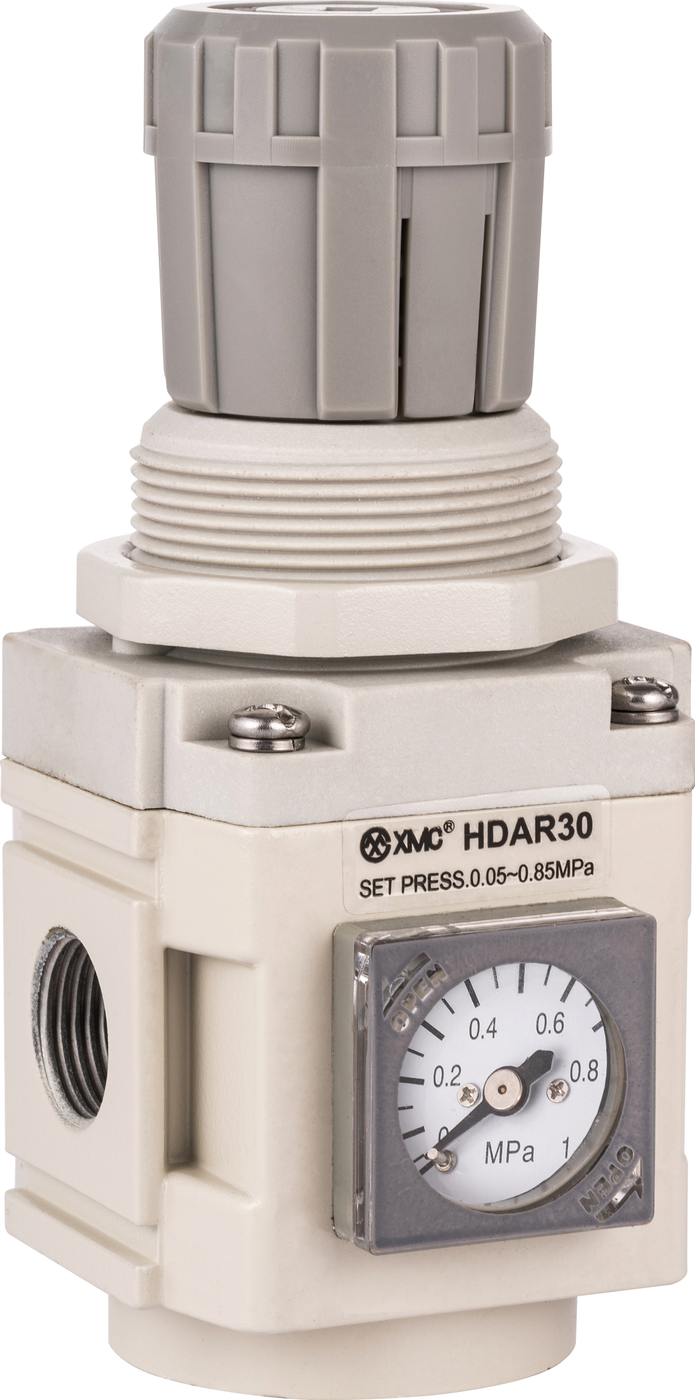
Choose a general-purpose air regulator when its documented pressure and flow characteristics meet the machine's requirements. Consider a precision regulator when fine adjustment or repeatable pressure control is critical to the process. Specify the permitted pressure variation and operating conditions before comparing models. The word precision alone does not guarantee a particular accuracy, airflow or response time.
What is the difference between an air regulator and a precision regulator?
Both reduce the supply pressure to a usable downstream pressure. In a conventional spring-loaded design, the setting mechanism and pressure feedback govern a valve that admits air as demand changes. Precision models are intended for finer pressure adjustment within their specified range. A regulator controls pressure; it is not a substitute for a flow-control valve. [2] For purchasing, the useful distinction is whether the candidate's documented performance fits your pressure tolerance and demand, rather than whether the name sounds more advanced.
Define the pressure requirement before comparing products
Write down the target pressure, the allowable high and low limits, and where those limits apply: directly at the regulator outlet or at the working device. State whether the requirement applies at rest, during a stroke or after a settling period. For an illustrative fixture, a stable reading before contact may be insufficient if pressure changes during the working motion. Describe that sequence in the inquiry; it is a selection scenario, not a verified XMC application result.
Compare the specifications that answer different questions
Sensitivity, repeatability and pressure stability describe different aspects of regulation. SMC's IR operating manual distinguishes fine setting sensitivity from repeatability after downstream operation, and explains that its repeatability figure excludes effects such as temperature change and aging. [3] Keep the operating pressures and flow-reference conditions with every specification in the comparison. Ask for the candidate model's definitions and test conditions before comparing numbers.
| Characteristic | Selection question |
|---|---|
| Setting range | Can the required setpoint be used within the stated operating range? |
| Setting sensitivity | How small an adjustment can be made under the manufacturer's stated conditions? |
| Repeatability | How closely does outlet pressure return after the specified operating cycle? |
| Hysteresis | How does the result depend on the direction of the specified pressure or flow change? |
| Flow characteristic | What outlet pressure remains at the required flow and inlet pressure? |
| Supply-pressure characteristic | How much does outlet pressure change when inlet pressure changes? |
| Air consumption | Is a continuous bleed present, and at what stated conditions is it measured? |
Where HDAR, HDAW and HIR fit in an XMC selection review
HDAR provides pressure regulation within the HDA modular range. HDAW combines a filter and regulator. HIR is a separate precision-regulator family. The XMC catalogue lists the following set-pressure ranges. [1] These ranges identify candidates; they do not prove that any two products share flow capacity or regulation performance.
| Family | Function | Listed pressure setting range |
|---|---|---|
| HDAR20-40 | Air regulator | 0.05-0.85 MPa |
| HDAW20-40 | Combined filter-regulator | 0.05-0.85 MPa |
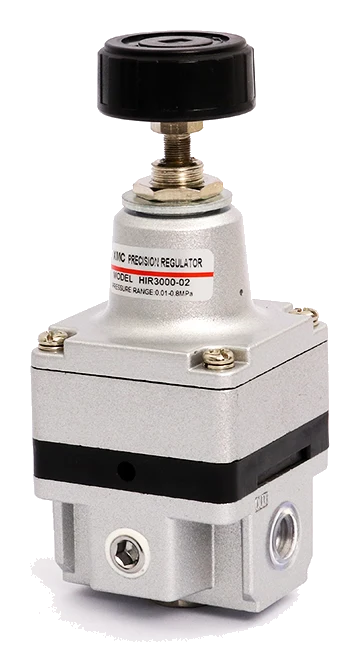
| HIR2000/3000/4000 | Precision regulator; configuration varies | Options: 0.01-0.2, 0.01-0.4 or 0.01-0.8 MPa |
Read HIR precision figures on the correct basis
Printed page 76 lists HIR sensitivity within 0.2% of full span and repeatability within ±0.5% of full span. [1] Full span is not the pressure presently shown on the gauge. Neither figure is a blanket promise that outlet pressure stays within that percentage during every flow or supply change. Ask XMC to confirm the applicable span, configuration and measurement conditions for the quoted model. For a critical process, include acceptance measurements at your operating point in the selection discussion.
Check flow demand and the supply path
Check the exact model's pressure-versus-flow curve against the required peak flow and inlet pressure. The HDAR and HDAW plots appear on printed pages 55 and 59. [1] Request applicable performance data for a proposed HIR model. Record overlapping air users and the lowest available supply pressure. A larger port or a precision label cannot establish that an upstream restriction has been resolved. If the present complaint is pressure falling during movement, measure inlet and outlet pressure during the same event before choosing a replacement.
Include air preparation, venting and installation
HIR separates the pilot vent from the main vent, and its catalogue includes air-consumption information. [1] Confirm the required filtration, permitted supply conditions and vent arrangement with the selected model's instructions. Do not plug an operating vent to eliminate a perceived leak. Include bleed consumption in the air-demand review. Where a filter-regulator feeds another regulator, have the available inlet pressure and pressure losses checked for the complete arrangement rather than assuming that two regulation stages automatically improve the result.
Send a selection brief that can be evaluated
Send the target pressure and acceptable deviation, inlet-pressure range, flow range with reference conditions, and operating sequence. Add the complete existing model, connection thread, installation space, air-quality information and a circuit sketch. Identify where pressure will be measured and what instrument will be used. For a trial, agree the pass criteria before testing: record the same cycle, pressure limits and recovery requirements for each candidate. This gives purchasing and engineering a shared basis for judging the quotation.
Catalogue and technical references
XMC model details come from the catalogue pages below. Other manufacturers' documents support the explanation of regulation characteristics; their ratings and installation permissions are not transferred to XMC products.
Questions buyers ask.
Is a precision air regulator always the better choice?
Choose by the pressure tolerance, demand and installation requirements. If an appropriately sized general-purpose regulator meets those requirements, its selection does not become inadequate simply because a precision model exists.
Does HDAW provide the same function as HIR?
HDAW combines filtration and pressure regulation. HIR is a precision-regulator family. Confirm any upstream air-treatment requirements for HIR separately; do not treat the two families as direct replacements based on pressure range alone.
Will a precision regulator fix pressure drop under load?
Only if the selected unit and complete supply path meet the required flow and pressure conditions. Measure the existing circuit first. Restricted fittings, insufficient supply or undersized tubing require their own assessment.
Does a finer gauge make a standard regulator a precision regulator?
A different gauge changes how pressure is observed; it does not establish different regulator characteristics. Check the regulator specifications and use an instrument suitable for the pressure tolerance and speed of the event being measured.
Technical references
- [1] XMC Huayi product catalogue, edition 21 June 2025: HDAR printed pages 54-55, HDAW pages 58-59 and HIR pages 76-78. Pages 54, 58, 76 and 77 visually rechecked on 10 October 2026. HDAR and HDAW curves are in the HDA PDF; request applicable performance data for a proposed HIR model.
- [2] IMI Norgren, How do Pneumatic Pressure Regulators work? General operating principle, finer adjustment and selection considerations. Accessed 10 October 2026.
- [3] SMC, IR operation manual IR20-OM00002: setting sensitivity, full-span basis, repeatability conditions and air consumption. Used for terminology only. Accessed 10 October 2026.
Put the guide to work.
Choose the relevant XMC series, download its product PDF and include the application details with your inquiry.