
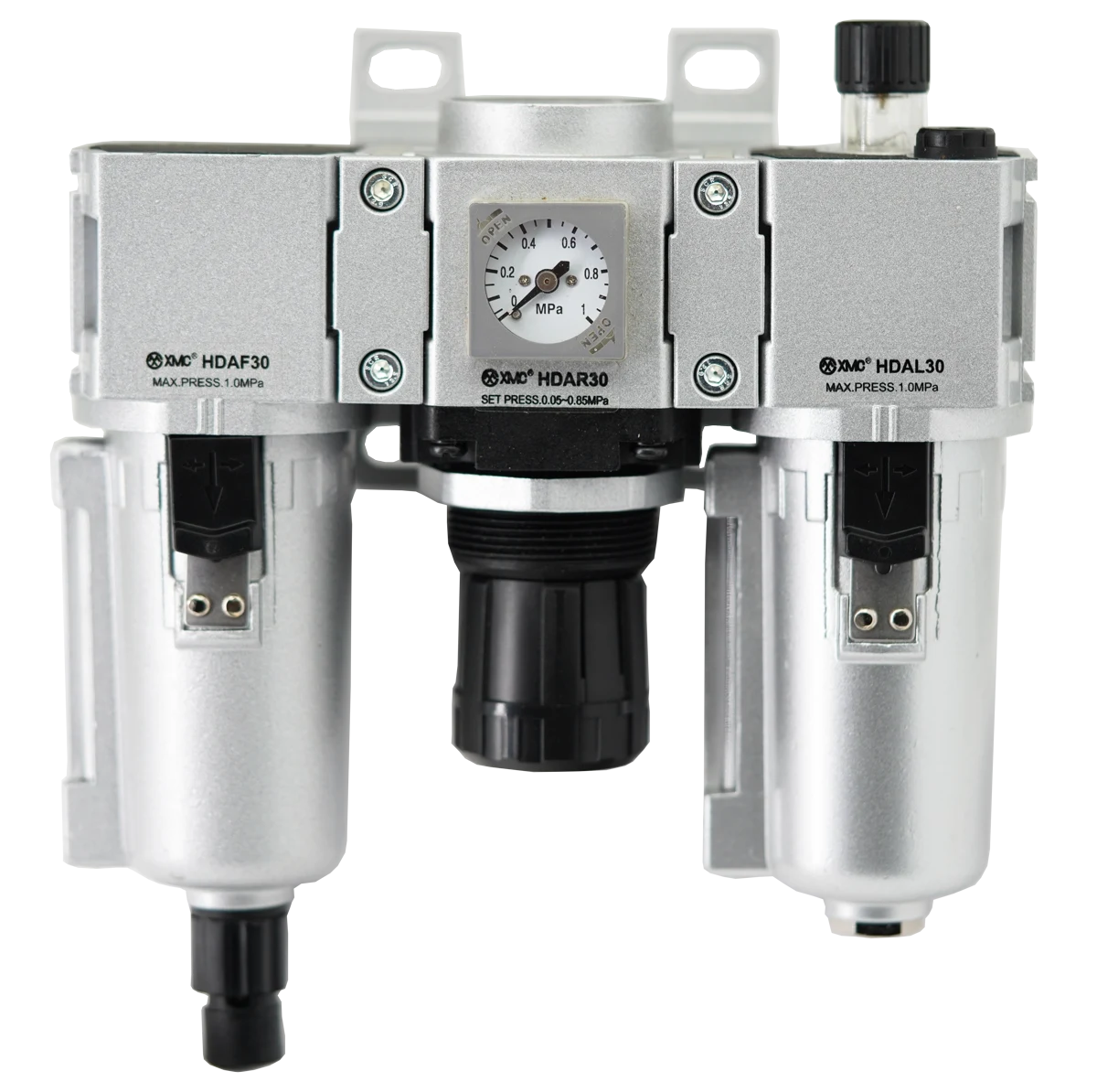
An HDAL lubricator that is not dripping is not automatically defective. Identify the exact unit, then compare normal airflow through that unit with its catalogue minimum: 15 L/min for HDAL20, 40 L/min for HDAL30 or 50 L/min for HDAL40. Confirm a common measurement basis before comparing the numbers. A reading above the minimum does not prove correct oil delivery; it means the oil, adjustment and installation checks still matter. Use the conditional checklist below before requesting a repair or a different size.
HDAL20, HDAL30 and HDAL40: the catalogue values
Printed page 56 of the XMC catalogue dated 21 June 2025 ties each minimum oil mist flow to a body size and specific model entries. Read the complete code on the installed lubricator, including any bowl option. A port adaptor does not change the HDAL body size. The catalogue table does not define the reference state or test procedure for these minimum-flow numbers. [1]
| Catalogue model | Listed port size | Minimum oil mist airflow |
|---|---|---|
| HDAL20-01 | 1/8 | 15 L/min |
| HDAL20-02 | 1/4 | 15 L/min |
| HDAL30-02 | 1/4 | 40 L/min |
| HDAL30-03 | 3/8 | 40 L/min |
| HDAL40-03 | 3/8 | 50 L/min |
| HDAL40-04 | 1/2 | 50 L/min |
Identify a standalone HDAL or the lubricator inside an assembly
The same connection size can occur on different body sizes with different minimum-flow entries: a 1/4 port appears on HDAL20 and HDAL30, while 3/8 appears on HDAL30 and HDAL40. Ports alone therefore cannot select the applicable row. HDAC three-piece and HDAC-A two-piece assemblies both retain lubrication. Their catalogue specification tables also list 15/40/50 L/min by body size 20/30/40. Confirm the actual installed components before applying a catalogue assembly entry, especially after a rebuild. [1]
| Installed arrangement | Catalogue reference | Identify before using a minimum |
|---|---|---|
| Standalone HDAL | HDAL20-40, printed page 56 | Complete HDAL code, body size, port and bowl option |
| HDAC three-piece F+R+L | HDAC20-40, printed page 48 | Complete assembly code and the lubricator actually fitted |
| HDAC-A two-piece FR+L | HDAC20-40A, printed page 50 | Confirm the A arrangement and the actual lubricator; two pieces still include oil addition |
Minimum misting flow is not maximum flow capacity
The minimum value concerns the airflow needed for oil mist delivery. It does not state the largest airflow the lubricator can carry at an acceptable pressure drop. Page 56 labels the minimum row L/min without defining reference conditions. The separate flow-characteristic plots on page 57 label their horizontal axis L/min (ANR). That plot label does not establish the unstated test conditions of the minimum-flow row. Do not relabel 15/40/50 as NL/min, ANR or SCFM. Ask XMC to confirm a comparable basis before using a flowmeter reading as a selection threshold. [1]
Check flow while the machine is consuming air
Pressure at a gauge does not by itself prove flow through the lubricator. A charged but idle branch can show pressure while consuming little or no air. Observe the sight-feed window during a representative machine cycle and record branch airflow, pressure and cycle timing together. A compressor rating or whole-factory consumption is not the airflow through this HDAL. SMC also identifies low air consumption as a general cause of absent dripping; that principle does not transfer its model ratings, test conditions or adjustment procedure to HDAL. [2]
Example: low demand on an HDAL30 branch
Suppose an HDAL30 branch is measured at 25 L/min while its tool is operating. Only if the reading and catalogue use comparable reference conditions is this below the listed 40 L/min minimum. Low flow then becomes a selection question to investigate, rather than proof of a broken lubricator. If the measurement basis is unknown, record it as unconfirmed instead of classifying the unit as undersized, oversized or faulty. This is an illustrative comparison, not a customer test. For intermittent demand, record cycle duration and the flow pattern so XMC can review the application; do not transfer another model's averaging rule.
Use a conditional no-drip checklist
Treat the table as an observation and selection record, not a repair procedure. First establish the model and the basis of the flow reading. A missing comparison basis is an open question. Being above a catalogue minimum is also not a guarantee of the required oil dose at the equipment.
| Observed condition | What it establishes | Next information or action |
|---|---|---|
| Machine idle or branch flow not recorded | Pressure alone cannot establish operating airflow | Record normal machine demand through this lubricator |
| Model known, flow reference conditions unknown | The measured number cannot yet be compared reliably | Ask XMC to confirm the catalogue basis and provide the flowmeter specification |
| Comparable operating flow below the model minimum | Low demand is a plausible selection issue | Review the demand pattern and suitable configuration; do not declare an internal fault |
| Comparable operating flow at or above the minimum, no visible feed | The minimum-flow comparison does not explain the whole symptom | Check oil identification, visible level, adjustment and installation using exact-unit instructions |
| Feed changes with short or intermittent cycles | One peak or idle reading does not describe the cycle | Provide a timed flow record and sight-feed video for application review |
| No feed after the applicable checks | The symptom needs model-specific inspection guidance | Contact XMC with the completed record before opening or replacing components |
Check the oil and metering adjustment
Record the visible oil level, oil identification and metering-adjustment position before requesting support. XMC specifies Turbine No. 1 oil, ISO VG32, for HDAL20-40. [1] An oil sold as compressor oil or hydraulic oil is not confirmed by that description alone. Follow the instructions supplied for the exact unit when checking or adjusting feed during normal demand. The catalogue does not provide a universal drops-per-minute setting or a complete servicing procedure. Ask for the appropriate instructions if they are missing, and agree the required lubrication with the downstream equipment supplier.
Verify orientation and operating limits
The HDAL catalogue specifies vertical installation within plus or minus 5 degrees, filtered compressed air, a maximum working pressure of 1.0 MPa, and ambient and fluid temperatures of 5-60 degrees Celsius. [1] Record the unit's flow-direction marking and the actual connection direction, and check access to the bowl and sight-feed window. Horizontal mounting is outside the stated orientation. These are operating boundaries, not evidence that a particular branch will receive adequate lubrication.
When no dripping calls for inspection
If the correct unit and measurement basis are confirmed, operating flow is suitable, and the oil, adjustment and installation checks do not explain the symptom, send the record to XMC for inspection guidance. A no-drip observation alone cannot identify which internal part has failed. Any opening, removal or repair must follow the exact unit's instructions and the machine's isolation procedure, with trained personnel controlling stored pressure and unexpected movement. General manufacturer guidance also requires depressurization before parts replacement. [2] Do not use another brand's dismantling sequence or torque values for HDAL.
Do not solve low-flow selection by guessing
A smaller lubricator may have a lower listed misting minimum, but it must also meet peak demand and acceptable pressure drop. Do not choose an HDAL20 solely because 15 is lower than 40. Review the minimum operating demand, peak demand, pressure, duty cycle, connection and installation envelope together. Increasing line pressure or deliberately wasting air to produce visible drops is not a substitute for matching the unit to the equipment. The downstream machine must first require externally lubricated air.
Send a configuration-specific record to XMC
Use the fields below when asking for HDAL support. For an HDAC or HDAC-A assembly, include both the assembly label and the actual lubricator identification, particularly if modules have been changed. Say whether feed never started, stopped suddenly or changes with demand. Keep unknown fields marked unknown. The response should confirm the measurement basis, suitability of the exact configuration and the applicable operating or inspection instructions before a repair or replacement order.
| Record field | Information to provide | What the review must resolve |
|---|---|---|
| Unit and configuration | Full HDAL code and label photo; full HDAC/HDAC-A code if assembled; changed modules and fittings | Which model, body size, port and options are actually installed |
| Demand and timing | Flow through the lubricator during normal cycles; minimum and peak demand; cycle duration | Whether oil feed can be supported across the intended operation |
| Measurement basis | Flowmeter units and reference conditions; measurement location; inlet/outlet pressure during that cycle | Whether measured flow can be compared with the catalogue minimum |
| Oil and visible feed | Oil brand/grade, visible level, adjustment position and short sight-feed video under normal demand | Which supplied operating checks or inspection instructions apply |
| Installation and history | Flow-direction marking, actual connection direction, orientation, temperature and when the symptom began | Whether conditions or a configuration change explain the symptom |
| Equipment requirement | Downstream machine model and its lubrication requirements; acceptable pressure drop | Whether this branch needs added oil and what an acceptable selection must achieve |
Questions buyers ask.
Will an HDAL lubricator start dripping if I just wait?
It may show feed when sufficient normal airflow resumes, but waiting does not diagnose the symptom. Identify the model, record operating flow on a confirmed basis, and follow the exact unit's oil, adjustment and installation checks.
Does 40 L/min mean an HDAL30 supplies 40 litres of oil per minute?
No. It is the catalogue's minimum airflow for oil mist delivery, not an oil consumption rate and not the lubricator's maximum air capacity.
Can HDAL be installed horizontally?
The XMC specification is vertical within plus or minus 5 degrees. Horizontal installation is outside that stated installation requirement.
Does every pneumatic machine need a lubricator?
Check the downstream equipment manufacturer's requirements before adding oil. If that equipment is specified for non-lubricated air, do not add an HDAL just because an FRL package includes one.
Does a two-piece HDAC-A avoid the lubricator minimum-flow check?
No. HDAC-A combines a filter-regulator with a lubricator. Its catalogue has minimum oil mist flow entries by body size. Confirm the full assembly and actual lubricator rather than assuming that two housings means no oil addition.
Can I compare an NL/min meter directly with the 15, 40 or 50 L/min figures?
Not without confirming the measurement basis. The HDAL minimum-flow table does not define reference conditions. Ask XMC to clarify them and provide the flowmeter's reference conditions before comparing values.
Technical references
- [1] XMC product catalogue, edition 21 June 2025: printed pages 56-57, HDAL model/port/minimum-flow table, operating limits, ordering and flow-characteristic plots; pages 48 and 50, HDAC and HDAC-A functions and minimum-flow entries. https://www.xmcfluid.com/assets/documents/product-pdfs/en/hda-series-air-preparation-units.pdf
- [2] SMC, operation manual ALx-OMD0103-A, Selection and Maintenance sections: general low-consumption and depressurization principles only. Its model ratings, flow-test conditions, adjustment settings and servicing instructions do not apply to HDAL. https://www.smcworld.com/upfiles/manual/en-jp/files/ALx-OMD0103.pdf
Put the guide to work.
Choose the relevant XMC series, download its product PDF and include the application details with your inquiry.