
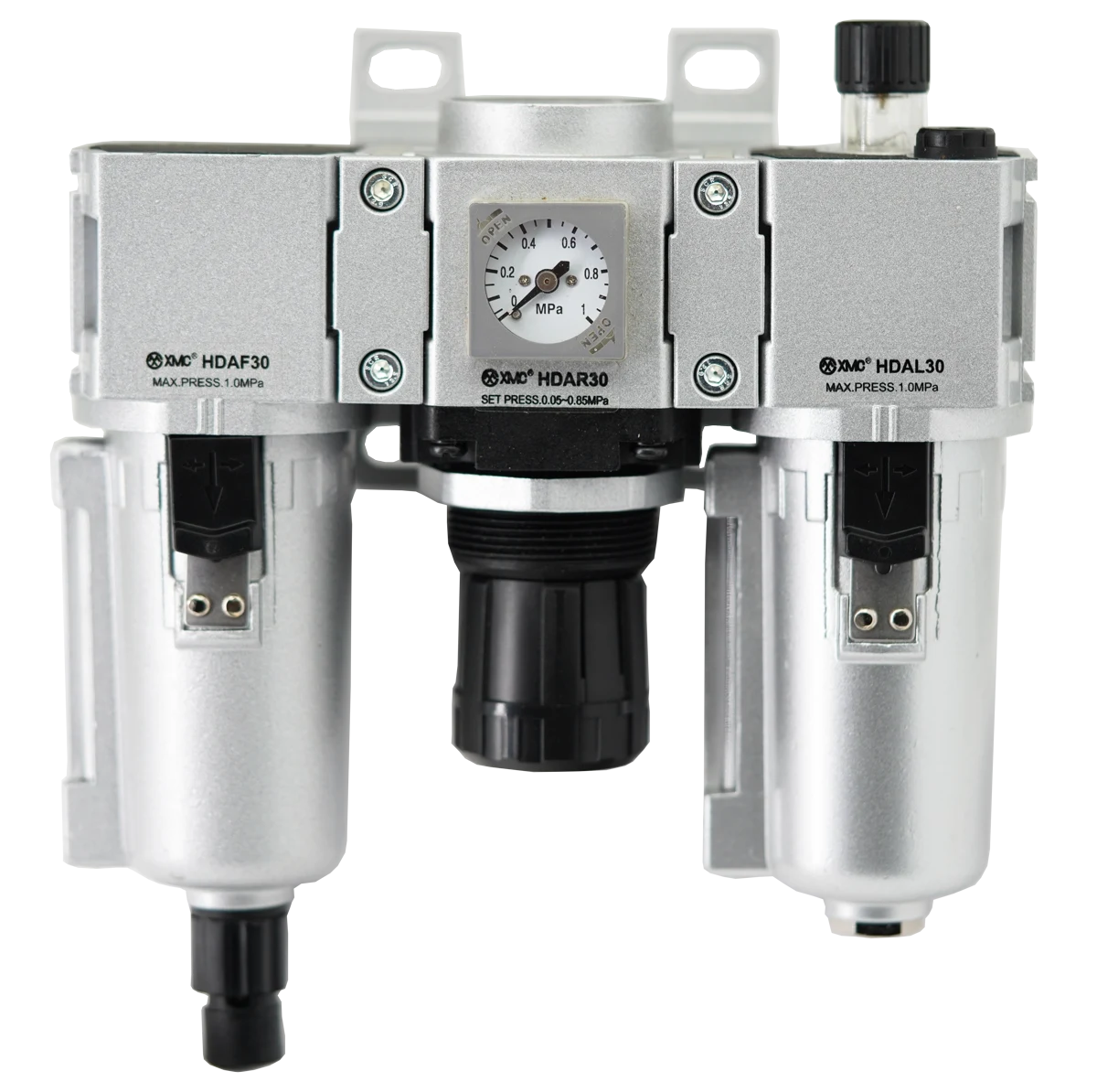
Select an air preparation unit by defining the downstream air-quality requirement, pressure during operation and actual demand. Choose filtration, regulation and any lubrication separately; then review the required HA or HDA components, drain, connections and service space. Mist separation, liquid-water separation, vapour drying and startup or venting control answer different requirements. Confirm the exact configuration and its catalogue conditions before ordering.
1. Define the air requirement at the point of use
Write down what the air will serve: a machine supply, a shared distribution branch, a measuring circuit or a specific tool. Record the treatment already installed upstream and the air condition required by each downstream device. Keep particle, water and oil requirements separate. A line feeding several machines may need different pressure settings or lubrication arrangements after it divides. Identify those branches on a simple drawing before choosing a combination unit. If the equipment specification gives an air-quality class, send the complete requirement to XMC; a filter's micron value alone does not establish that class. This guide identifies functions and candidate families. Use the linked specialist guides for detailed sizing and troubleshooting.
2. Separate filtration, mist removal and water-vapour control
First identify the contamination and its form. HDAF and HAF are general air-filter ranges; HDAFM and HAFM are separate mist-separator ranges. [1-3] Choosing a finer particle element does not establish an oil-content limit or a pressure dew point. Water already collected as liquid also differs from water vapour: vapour can condense later if the air cools. Festo describes drying methods that reduce water vapour and the pressure dew point. [8] The XMC HID40 page describes centrifugal liquid-water separation, but gives no pressure-dew-point rating. [3] Review a drying requirement separately rather than assuming that a product name or an empty filter bowl proves the air is dry enough.
3. Choose HDA functions before deciding the module count
The HDA catalogue distinguishes HDAF filtration, HDAR pressure regulation and HDAL oil-mist lubrication. HDAW combines filtration and regulation in one module. HDAC uses separate filter, regulator and lubricator modules; the two-piece HDAC-A arrangement uses an HDAW filter-regulator and an HDAL lubricator. Both combinations include lubrication. [1] A two-piece combination therefore does not mean a filter plus regulator with no oil addition. For non-lubricated equipment, ask XMC to review filtration and regulation without adding a lubricator. Compare the complete ordering code, drawing, mounting space and service access. A shared size number is not permission to substitute connectors or accessories.
| Family | Functions | Selection question |
|---|---|---|
| HDAF | Filtration | What element, drain and air-quality requirement apply? |
| HDAR | Pressure regulation | What outlet pressure is required during demand? |
| HDAL | Lubrication | Does the equipment require oil, and can the lubricator operate across the duty range? |
| HDAW | Combined filtration and regulation | Does the integrated layout fit the approved circuit and service space? |
| HDAC / HDAC-A | Filtration, regulation and lubrication | Three separate modules or a filter-regulator plus lubricator? |
4. Review HA and large-port components against the branch duty
The HA range includes HAC filter-regulator-lubricator combinations. Its large-port HAF filters, HAR regulators and HAL lubricators are documented as separate component families. [2] For a larger distribution branch, select each required function and review the complete connected arrangement. Do not assume a matching regulator and lubricator exist for every filter port, or that separate HA components couple directly into a matched station. The branch drawing should show shared demand, downstream pressure requirements and which users permit lubrication. Family names alone do not establish capacity, installation fit or interchangeability. The large-port guide covers the HA catalogue conditions and component-port differences in detail.
5. Add lubrication only for equipment that requires it
Confirm the equipment manufacturer's lubrication instructions before specifying HDAL, HAL or a combination that includes one. A mist separator removes unwanted contamination; a lubricator deliberately introduces oil for an approved lubrication task. Norgren distinguishes uncontrolled carry-over oil from controlled lubrication. [9] Keep users with different requirements identifiable in the circuit review. Where lubrication is required, confirm the oil, the minimum operating flow and performance across the actual cycle. The HDAL and HAL catalogues label a minimum oil-mist flow; it is not the unit's maximum supply capacity. [1, 2] Do not choose an oil-feed setting from the port diameter or copy another manufacturer's drip guidance.
6. Define pressure control and precision separately
Use the pressure needed while the equipment is operating, and identify where that pressure must be achieved. HAR and HDAR provide pressure regulation; HDAW adds filtration in the same module. [1, 2] For a pressure-sensitive task, give XMC the permitted variation, inlet-pressure range and changing demand so HIR can be reviewed against its own catalogue data. [4] An adjustment range is not an accuracy or repeatability rating. Norgren's guidance likewise distinguishes inlet pressure, controlled outlet pressure, control precision and flow. [7] Do not treat a regulator as a flow controller or assume a precision family solves an undersized upstream air path.
7. Size the complete air path at the operating conditions
Record the lowest available inlet pressure during the demanding sequence, the pressure required downstream, the users operating together and how long the overlap lasts. Include minimum demand when a lubricator is proposed. State flow units and reference conditions; two L/min values with different pressure conditions are not automatically comparable. Check the exact model's applicable flow data and restrictions in connectors, tubing, valves and treatment stages. Festo identifies service-unit restrictions, long lines, branches and leakage as contributors to insufficient flow and pressure. [6] A matching port size or an idle gauge reading does not prove the supply is adequate during the cycle. Use the sizing guide for the detailed demand and pressure-drop review.
8. Specify startup control and venting separately from regulation
An air-treatment selection may also need a defined startup and isolation sequence. The HAV catalogue describes restricted initial filling followed by normal supply, with downstream pressure release when the valve closes. The HVHS catalogue describes a manually operated, lockable three-port venting valve. [5] These functions differ from pressure regulation and from each other. Have the machine designer identify the required circuit position, control method, exhaust route and volumes that may retain pressure. The product name does not establish a safety category, certification or complete lockout procedure. Confirm the exact models and arrangement rather than extending published HAV or HVHS information to an unverified series.
9. Send a selection brief that includes drainage and service access
A usable selection brief connects the air requirements with the installation. Specify condensate conditions, drain access and a suitable discharge route. Automatic drainage still needs the correct operating conditions and inspection. Confirm the delivered thread form, bowl and cover, mounting orientation, gauge or switch and service clearance. For a replacement, include the complete existing code, nameplate and drawing rather than asking for a visual match. Before fitting or servicing components, use the machine's approved isolation and depressurization procedure and secure loads. Mark unknown inputs as unknown so they can be resolved before ordering.
| Input | What to provide |
|---|---|
| Application and layout | Users, branch drawing, existing treatment and new-build or replacement scope. |
| Required air condition | Particle, liquid-water, water-vapour and oil requirements; the equipment specification where available. |
| Pressure and demand | Flowing inlet pressure, required outlet pressure, measurement points, minimum and peak demand, units and reference conditions. |
| Functions and candidate models | Filtration, regulation, lubrication, mist separation, liquid-water separation and startup or venting functions. |
| Configuration and environment | Thread, drain, bowl and cover, gauge or switch, ambient conditions, mounting and service space. |
| Purchasing scope | Quantity, destination, requested documentation and delivery date for confirmation. |
Catalogue and technical references
Product identities and functions come from the XMC catalogue extracts linked below. The HDA PDF includes HDAC on printed pages 48 and 50, HDAF on 52, HDAR on 54, HDAL on 56 and HDAW on 58. The HA extracts distinguish HAC combinations from separate large-port components. External references explain general principles; their ratings, air-quality classes, accessories and installation limits are not assigned to XMC products.
- [1] XMC HDA catalogue: printed pages 48-59
- [2] XMC HA combinations: printed pages 24-28
- [2] XMC HAF: printed page 29
- [2] XMC HAR: printed page 30
- [2] XMC HAL: printed page 31
- [3] XMC HDAFM: printed page 60
- [3] XMC HAFM: printed pages 32-33
- [3] XMC HID40: printed page 85
- [4] XMC HIR: printed pages 76-78
- [5] XMC HAV: printed pages 81-82
- [5] XMC HVHS: printed page 80
Questions buyers ask.
Does every pneumatic system need a complete FRL?
No. First specify filtration, pressure regulation and the downstream lubrication requirement. Both HDAC three-piece and HDAC-A two-piece combinations include a lubricator. For equipment requiring non-lubricated air, review the required filter and regulator functions without automatically adding oil.
Can a finer air filter replace a mist separator or dryer?
A particle-size rating does not establish outlet oil content or a pressure dew point. Identify particles, oil mist, collected liquid water and water vapour separately. Use appropriate product data for each treatment requirement rather than treating every filter as a complete air-drying system.
When should I compare HA large-port components with HDA?
Start from the branch duty, required functions and installation. HAF, HAR and HAL are separate large-port component families; HDA offers its own components and combined layouts. Confirm capacity, threads, dimensions and connectors for the proposed arrangement. Family names do not establish a direct replacement or a matched assembly.
Is a two-piece HDA combination oil-free?
No. The documented HDAC-A two-piece arrangement contains an HDAW filter-regulator and an HDAL lubricator. It performs filtration, regulation and lubrication. Module count alone does not tell you whether oil is added.
What information is needed if I do not know the model?
Send the application, a circuit or installation drawing, required air condition, inlet and outlet pressure, operating demand, connections, drain and lubrication requirements, service space, quantity and destination. State unknown values clearly; XMC can review a suitable family and the information still needed.
Technical references
- [1] XMC Huayi Pneumatic Catalogue, edition 21 June 2025, printed pages 48, 50, 52, 54, 56 and 58: HDA combination and component functions; original supplied PDF pages visually reviewed 23 October 2026.
- [2] XMC Huayi Pneumatic Catalogue, edition 21 June 2025, printed pages 24-31: HAC combinations and separate HAF, HAR and HAL large-port components. Product identities and functions reviewed 23 October 2026; no assembled-station rating inferred.
- [3] XMC Huayi Pneumatic Catalogue, edition 21 June 2025, printed pages 32, 60 and 85: HAFM/HDAFM mist separators and HID40 centrifugal liquid-water separation. No pressure-dew-point rating is assigned by this guide.
- [4] XMC Huayi Pneumatic Catalogue, edition 21 June 2025, printed page 76: HIR precision-regulator functions and selection options; visually reviewed 23 October 2026. No numerical accuracy claim is made here.
- [5] XMC Huayi Pneumatic Catalogue, edition 21 June 2025, printed pages 80-81: HVHS manual lockable venting and HAV soft-start functions; visually reviewed 23 October 2026. No safety category or certification is inferred.
- [6] Festo, Compressed Air Preparation in Pneumatics, printed page 6: flow and pressure restrictions along the air path; accessed 23 October 2026. No Festo sizing margin or product rating is transferred.
- [7] IMI Norgren, How do Pneumatic Pressure Regulators work?: inlet and outlet pressure, required precision and flow as selection factors; accessed 23 October 2026.
- [8] Festo, Choosing the right compressed air dryer: a guide: water-vapour reduction and pressure-dew-point control differ from collected-liquid removal; accessed 23 October 2026. Its dryer performance values are not XMC ratings.
- [9] IMI Norgren, What is a Lubricator?: controlled oil addition differs from unwanted oil carry-over; accessed 23 October 2026. Its lubricator types and operating instructions are not assigned to XMC.
Put the guide to work.
Choose the relevant XMC series, download its product PDF and include the application details with your inquiry.