
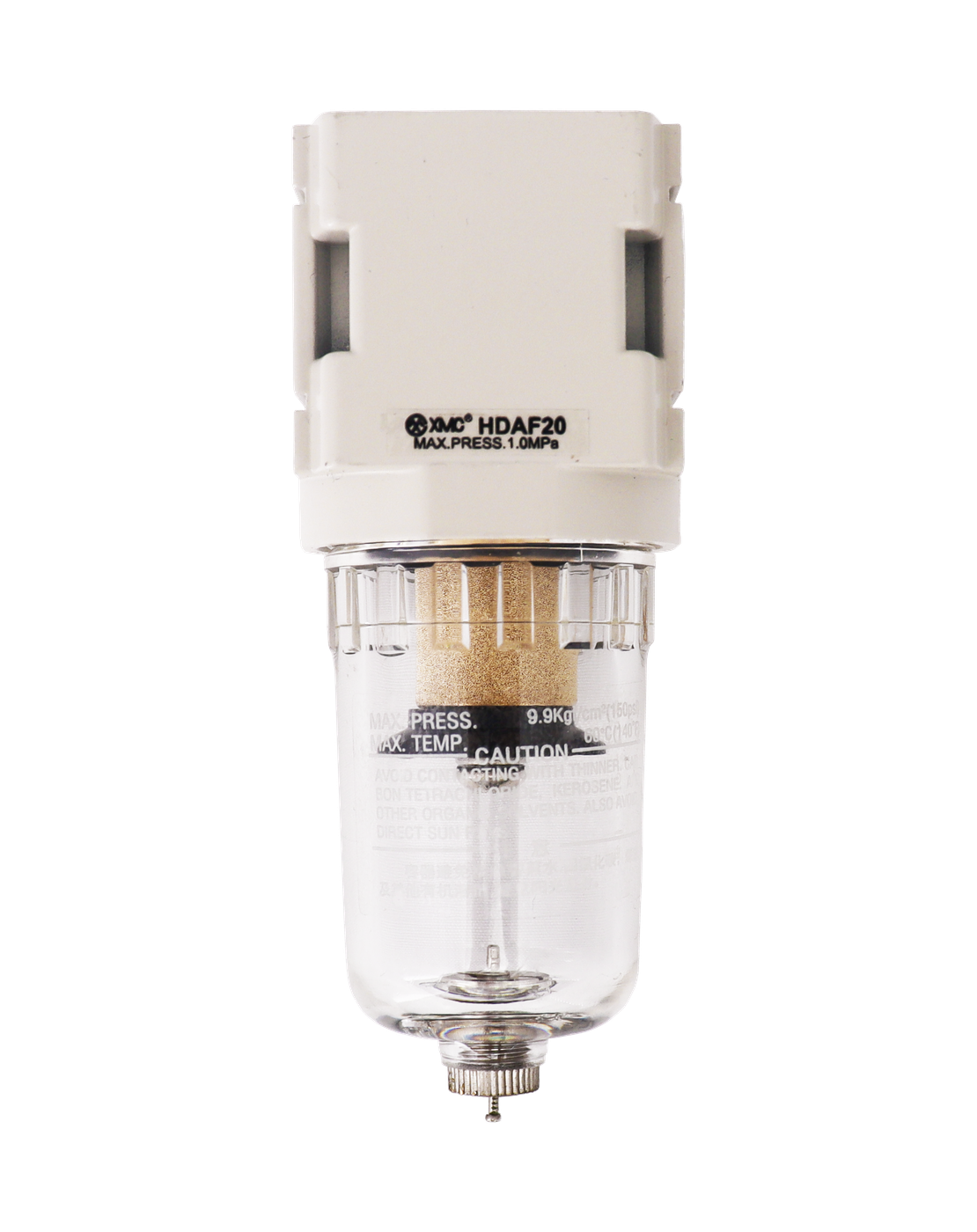
Water downstream of a pneumatic air filter does not automatically mean the filter element has failed. First distinguish liquid carried through the treatment system from water that condenses later in the piping. Check the installed drain, operating flow and air-drying arrangement. If the requirement is to control water vapour, specify a suitable pressure dew point and review the dryer; changing a filter's micron grade does not establish that dew point.
Separate collected water from water vapour
Moisture enters with the air drawn into the compressor. As compressed air cools, some of that moisture can condense into liquid. Atlas Copco's drying guidance distinguishes the removal of condensate from treatment of the remaining water vapour. [2] A bowl containing water and a wet hose farther downstream therefore describe different inspection points. Record both rather than treating them as the same fault. Also distinguish water from oil or other process contamination before selecting treatment; a photograph of a wet component rarely answers that question on its own.
| Function | Question it answers | What it does not establish |
|---|---|---|
| Liquid separation and collection | Where is existing condensate collected? | The remaining water-vapour content |
| Drainage | How is collected liquid removed from the bowl or separator? | A guaranteed downstream pressure dew point |
| Air drying | What moisture level or pressure dew point must be maintained? | That every local drain and filter is working correctly |
Start with where and when the water appears
Sketch the route from the compressor and receiver through any dryer, filters, distribution pipe and machine inlet. Mark the first location where liquid is observed. Note whether it appears during startup, sustained demand, cold weather or a particular production cycle. This creates a useful troubleshooting record for the plant-air supplier and machine builder. It also prevents an expensive local component change based only on water found at the far end of a long hose.
| Observation | Next check | Avoid this assumption |
|---|---|---|
| Liquid level stays high in the filter bowl | Identify the drain type and check its operation against its instructions | A new element alone will empty the bowl |
| Water appears beyond a cooler pipe section | Compare local temperature with the pressure dew point at the relevant operating pressure | The filter must have passed all of that water as liquid |
| Problem occurs only at peak machine demand | Record running flow, inlet pressure and treatment-equipment limits | An idle pressure reading represents production conditions |
| Several machines become wet at the same time | Review the shared supply, dryer condition and any bypass arrangement | Every point-of-use filter failed independently |
| Only one branch is affected | Inspect that branch's layout, local treatment and service history | A whole-plant dryer replacement is already justified |
Confirm which drain is actually installed
Read the complete HDA model and compare it with the order or service record. XMC's catalogue includes different drainage choices; their operating behaviour should not be inferred from the outside appearance alone. [1] Ask maintenance to check the relevant drain instructions, condensate path and discharge arrangement. A drain that needs manual attention requires an assigned routine, while an automatic arrangement still needs an operational check. Use the exact configuration's requirements when reviewing minimum pressure or shutdown behaviour.
Use pressure dew point for the downstream temperature question
Pressure dew point is the temperature at which water begins to condense at a stated compressed-air pressure. It must not be confused with a dew-point value measured after expanding the air to atmospheric pressure. Atlas Copco identifies the required pressure dew point as a key dryer-selection input. [3] Ask for a value at the relevant operating conditions and compare it with the coldest downstream conditions. A dryer description without those conditions is not enough to decide whether a cold section of pipe will remain free of condensate. For example, in a hypothetical line staying at the same pressure, a +5 °C pressure dew point and cooling to +2 °C allow condensation. Those values illustrate the principle; they are not XMC product ratings or a recommended setpoint for every machine. [3]
Review the dryer at actual production demand
If a dryer is installed, send its model, current status and service history with the investigation. Include operating pressure, inlet temperature, peak air demand and the conditions used to report that demand. Ask its supplier to assess capacity under those conditions and verify the delivered pressure dew point where needed. Check whether an open bypass or a recent production change alters the intended treatment route. These are information-gathering steps, not a conclusion that any particular dryer has failed or that a larger unit is automatically needed.
Where HDA filters and HDAFM mist separators fit
The reviewed XMC catalogue lists HDAF filters with 25 μm standard filtration and 5 μm or 50 μm options. HDAFM30/40 are separate mist separators listed at 0.3 μm and intended for initially filtered compressed air. [1][4] These catalogue descriptions do not state a dryer pressure-dew-point rating. Select the filter, mist-separation and drying duties against their respective requirements. A finer element may address a documented filtration need; it should not be ordered as an unverified cure for vapour condensing downstream.
Prepare a useful maintenance handover
Provide the circuit sketch, photographs of model labels, the location and timing of the water, drain observations and the production conditions. Include any measured pressure dew point with its pressure, location and measurement method. State the machine builder's required air quality and whether the issue affects product quality, tool operation or both. Before opening any pressurised bowl or component, maintenance personnel must follow the equipment's isolation and depressurisation procedure. Keep the troubleshooting record with the corrective action so the next inspection can use comparable conditions.
Catalogue and technical references
The model descriptions below come from XMC's catalogue. Atlas Copco references explain general moisture and drying principles; they do not certify XMC outlet-air quality. The temperature example is hypothetical. Obtain model-specific operation and maintenance instructions before service.
Questions buyers ask.
Why is there still water after my pneumatic air filter?
Check whether collected liquid is not being drained, treatment equipment is operating outside its conditions, or water vapour condenses farther downstream. Record the location and timing before deciding which component needs attention.
Will a 5 micron element remove water vapour?
Its micron grade does not establish a pressure dew point. Review the required drying duty separately from the particle-filtration requirement.
Does an automatic drain replace a compressed-air dryer?
No. The drain removes collected liquid. A dryer is selected to control moisture to the required conditions; both functions may be needed in one system.
Which pressure dew point should I specify?
Use the downstream equipment's requirement and the coldest expected conditions at the relevant pressure. Ask the dryer supplier to confirm performance at the actual flow and inlet conditions rather than choosing one value for every application.
Should I replace the filter immediately if I see water?
Water alone does not identify an element fault. Check drainage, operating conditions and the air-treatment route, while also following the filter's own service requirements. Send the findings with the complete model to the supplier.
Technical references
- [1] XMC Huayi catalogue, 21 June 2025, printed pages 52–53: HDAF specifications, ordering and drainage choices; reviewed September 2026.
- [2] Atlas Copco, Drying compressed air: condensate and water-vapour treatment; accessed 23 September 2026.
- [3] Atlas Copco, Choosing a compressed-air dryer: pressure dew point and dryer-selection requirements; accessed 23 September 2026.
- [4] XMC Huayi catalogue, 21 June 2025, printed page 60: HDAFM30/40 specifications; visually reviewed 23 September 2026.
Put the guide to work.
Choose the relevant XMC series, download its product PDF and include the application details with your inquiry.